EU chooses secrecy over transparency on data centers’ environmental cost
The EU faced a choice: reveal the environmental cost of data centers or protect the industry’s secrets. A year-long battle for answers across all 27 member states shows how European authorities chose commercial secrecy – and how a first-of-its-kind legal challenge could change that.
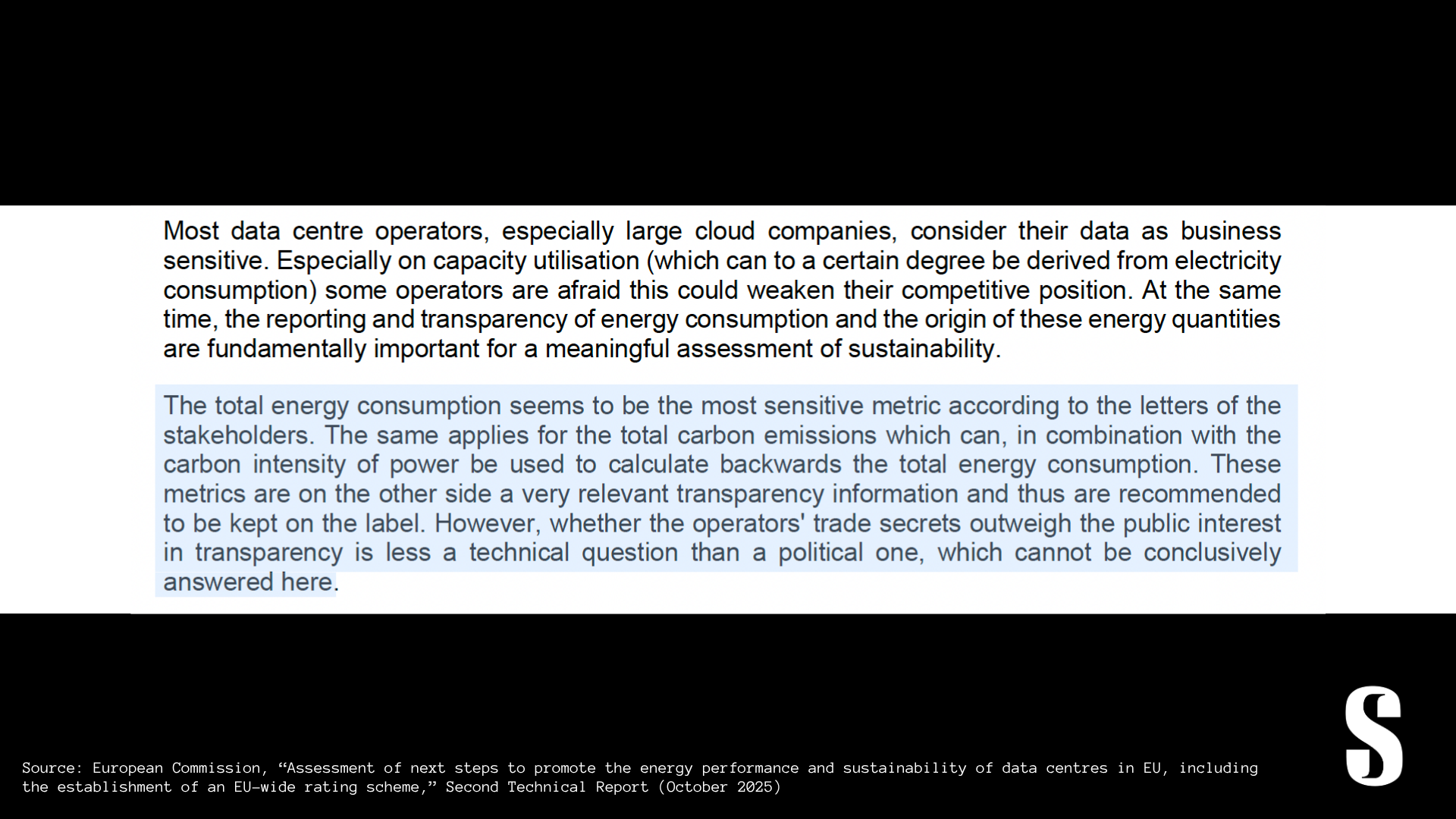
European officials faced a political choice over their proposed sustainability rating system for data centers: make consumption figures public or protect the industry’s commercial secrets. A study they commissioned made that choice explicit. They chose secrecy.
A year-long investigation by Solomon and its partners found that the proposed system would keep crucial energy and water consumption figures from public view while relying on incomplete and flawed data.
Unveiled by the European Commission this month and described in media coverage as potentially the most comprehensive of its kind in the world, the proposal promises “transparent information about the actual use of resources (energy, water)” by data centers. These facilities underpin Europe’s massive digital expansion and contribute to its growing environmental footprint.
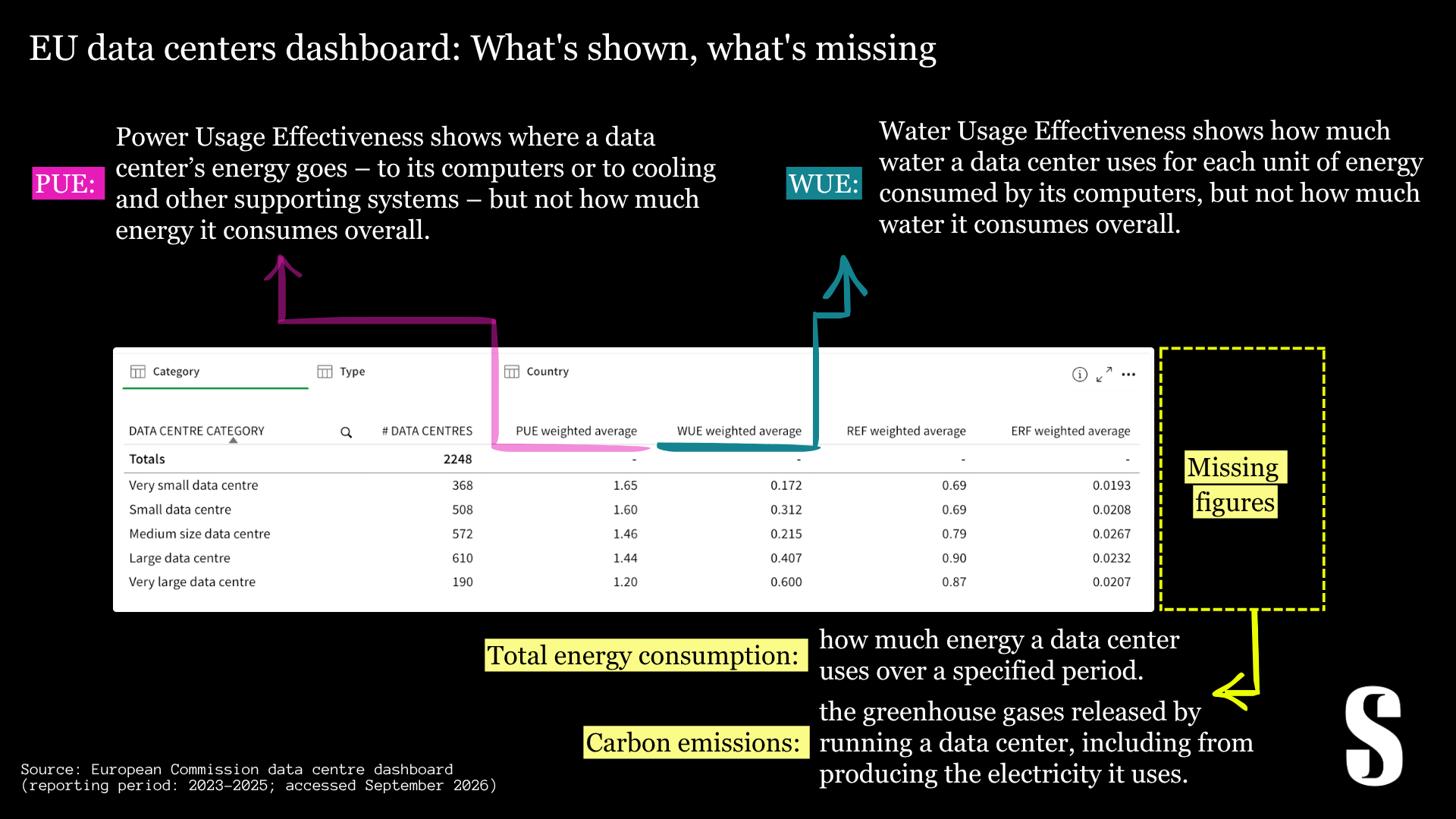
Yet the rating system would show how efficiently individual facilities use energy and water, while keeping their total consumption and carbon emissions confidential.
For communities living near data centers, those totals answer a basic question: How much electricity and water are the facilities around them using? As Europe expands the infrastructure powering artificial intelligence (AI), the answers would help residents assess what that growth means for local supplies.
Led by Lighthouse Reports, journalists filed formal records requests with authorities in all 27 EU member states and the Commission. We requested basic information on data centers’ energy use, water consumption and sustainability performance, along with correspondence about the implementation of the reporting system.
Hundreds of exchanges, appeals and challenges to refusals uncovered missing reports, seemingly impossible efficiency readings and European officials encouraging submissions even when they contained little or no data.
Our investigation – conducted with Mediapart (France), El Confidencial (Spain), Il Manifesto (Italy) and Trouw (the Netherlands) – also examined how industry demands shaped the information the public will be allowed to see. And it revealed how difficult it is to obtain consumption figures that operators are required to report.
The secrecy is built into EU rules.
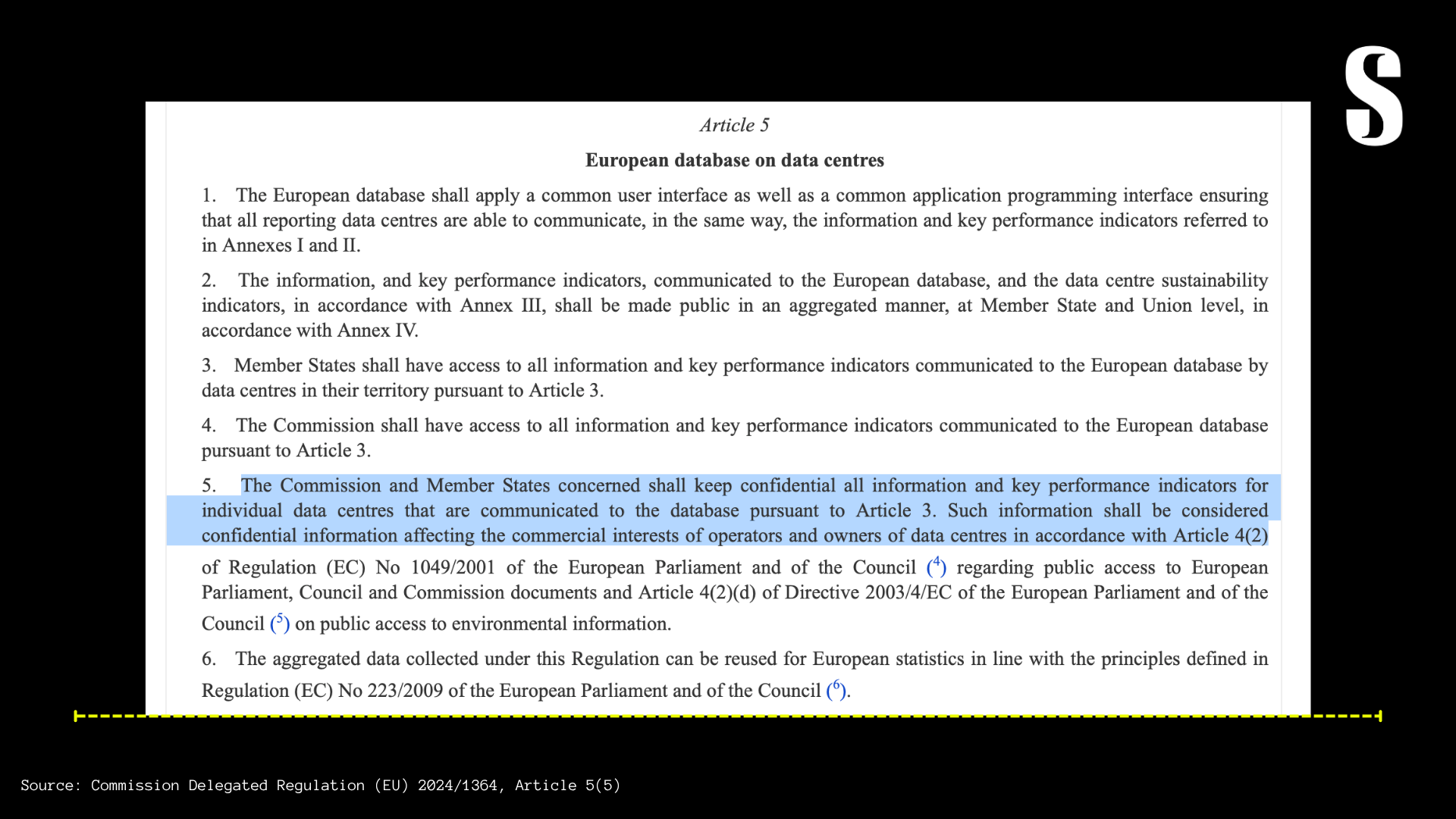
Data centers with an installed information technology capacity of at least 500 kilowatts must report their energy and water consumption. But the rules treat individual facilities’ submissions as commercially confidential, shielding them from public disclosure to protect companies’ business interests.
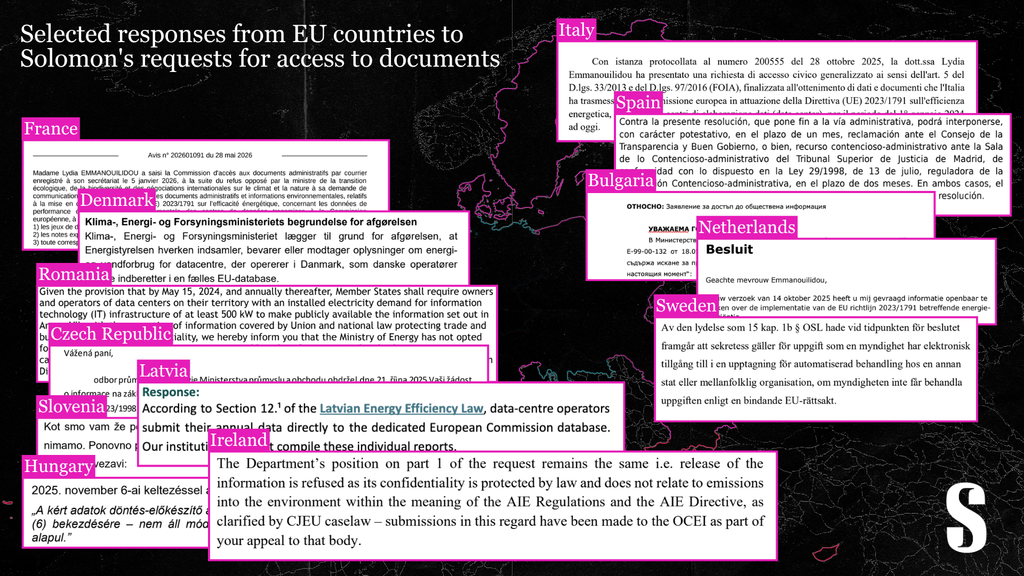
Those are the consumption figures we spent a year trying to obtain across the EU. Some governments called them commercial secrets. Others said they were held in Brussels. The Commission, which runs the European database, also refused to release them.
Two countries provided partial data that could not be linked to specific facilities. France supplied a spreadsheet but shuffled values between rows, leaving reporters unable to reliably connect a data center’s electricity use with its water consumption.
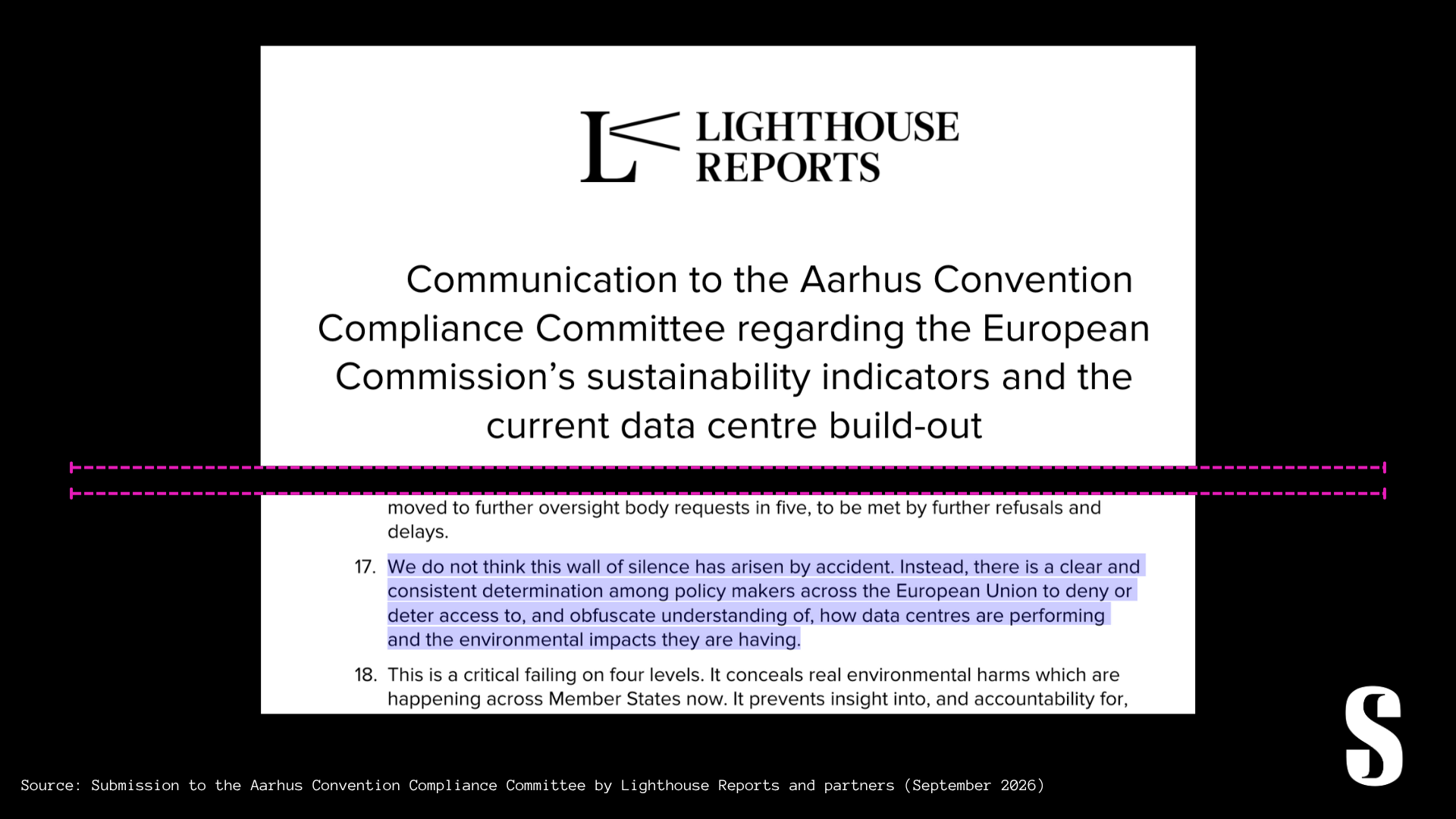
The findings underpin a first-of-its-kind legal challenge launched this week by our reporting consortium under the Aarhus Convention, a binding international treaty protecting access to environmental information. We argue that EU rules treating individual data centers’ environmental information as commercially confidential violate the treaty – both in their wording and in how authorities apply them to deny public access.
At stake is the public’s ability to understand – and have a say in – one of the defining environmental developments of our time: the enormous and accelerating build-out of data centers powering the AI boom, and its impact in their communities.
“There is a clear public interest in understanding the material impact that infrastructure of this scale may have, including its total water and electricity consumption,” said Nicolás González Casares, a Spanish Socialist Member of the European Parliament (MEP) who works on energy policy and the environmental impact of AI.
He added, “Protecting commercially sensitive information when necessary is one thing; systematically preventing the public from understanding this environmental impact is quite another.”
In response to our findings, the Commission defended the system, saying it had significantly improved transparency and that its confidentiality rules complied with EU law and the Aarhus Convention.
A “fairly useless” system?
Data centers are warehouses packed with computers and cooling systems that power everything from everyday online services to AI systems. They are vital to the development of the AI industry. They are also extremely energy-intensive, requiring vast amounts of electricity and, depending on how they are cooled, water.
In Ireland, data centers consumed nearly as much electricity as all the country’s homes combined in 2025 — accounting for 23 percent of recorded electricity consumption, compared with 28 percent for households. A decade earlier, data centers’ share was just 5 percent, according to the country’s statistics authority.
The EU aims to triple its data center capacity over the next five to seven years. That expansion comes amid a global backlash against data centers over their demands on electricity and water supplies. In parts of the United States, households are already paying higher electricity bills partly because of data centers’ growing demand for power.
“Every new data center stakes a claim on something a community needs, from the water we drink to the energy that heats our homes,” said Cori Crider, executive director of the Future of Tech Institute. “A smart plan for European compute would earn public support by being open about all build plans, and by relying on clean energy and careful water use.”
Europe’s proposed rating system would give data centers sustainability labels. Expected in 2027, these labels would assign facilities separate grades from A to G for energy and water efficiency.
Neither grade tells the public how much energy or water a facility consumes overall.
“I find it difficult to see this as a transparency measure,” said Christiaan van Veen, co-founder of Leitmotiv, a nonprofit focused on technology policy. Without those totals, van Veen described the measures as “fairly useless” for understanding the sector’s overall impact.
A sprawling data center could receive a better grade than a smaller one while consuming far more resources overall. Microsoft’s Middenmeer data center in the Netherlands illustrates the scale: it consumed 1.17 terawatt-hours of electricity in 2025, roughly 1 percent of the country’s entire electricity consumption that year, national media reported. An efficiency grade alone would not reveal that.
“The decision to focus on efficiency rather than absolute resource-use is an obvious flaw in the sustainability rating system,” said Lynn Boylan, an Irish Sinn Féin MEP who sits on the European Parliament’s environmental committee. “We need to know exactly how much pressure these behemoths are putting on already stretched public supplies.”
A political choice
The Commission had been advised to include total energy consumption and carbon emissions in its rating system. An October 2025 technical study it commissioned described transparency about energy consumption as “fundamentally important for a meaningful assessment of sustainability.”
Industry representatives consulted for the study opposed using those figures, identifying them as particularly sensitive information. The study’s authors disagreed. But whether operators’ commercial secrets outweighed the public interest in transparency, they observed, was ultimately “less a technical question than a political one”.
The scheme announced this month leaves both figures off the labels.
The outcome looks almost exactly like what the industry has been demanding. The Climate Neutral Data Center Pact, which brings together data center operators and trade associations, warned against using the ratings as a broader transparency tool and opposed publishing information about identifiable facilities. The European Data Center Association also sought to limit the information shown on the labels.
The industry’s push for secrecy began before the ratings. In 2024, the Commission adopted the rules requiring data centers to submit the information that the new grades will be based on. Those rules included a sweeping clause treating individual facilities’ submissions as commercially confidential.
The research and campaign group Corporate Europe Observatory recently documented how industry lobbying shaped those rules. Microsoft and the trade association DigitalEurope proposed confidentiality wording that the Commission incorporated almost word-for-word into the regulation.
Van Veen described a reversal of the usual approach: instead of requiring disclosure unless confidentiality could be justified, the detailed rules declared the information confidential from the outset.
“This is not normal,” he said. “This is apparently not a sector of the economy that is treated normally.”
A year asking for the figures
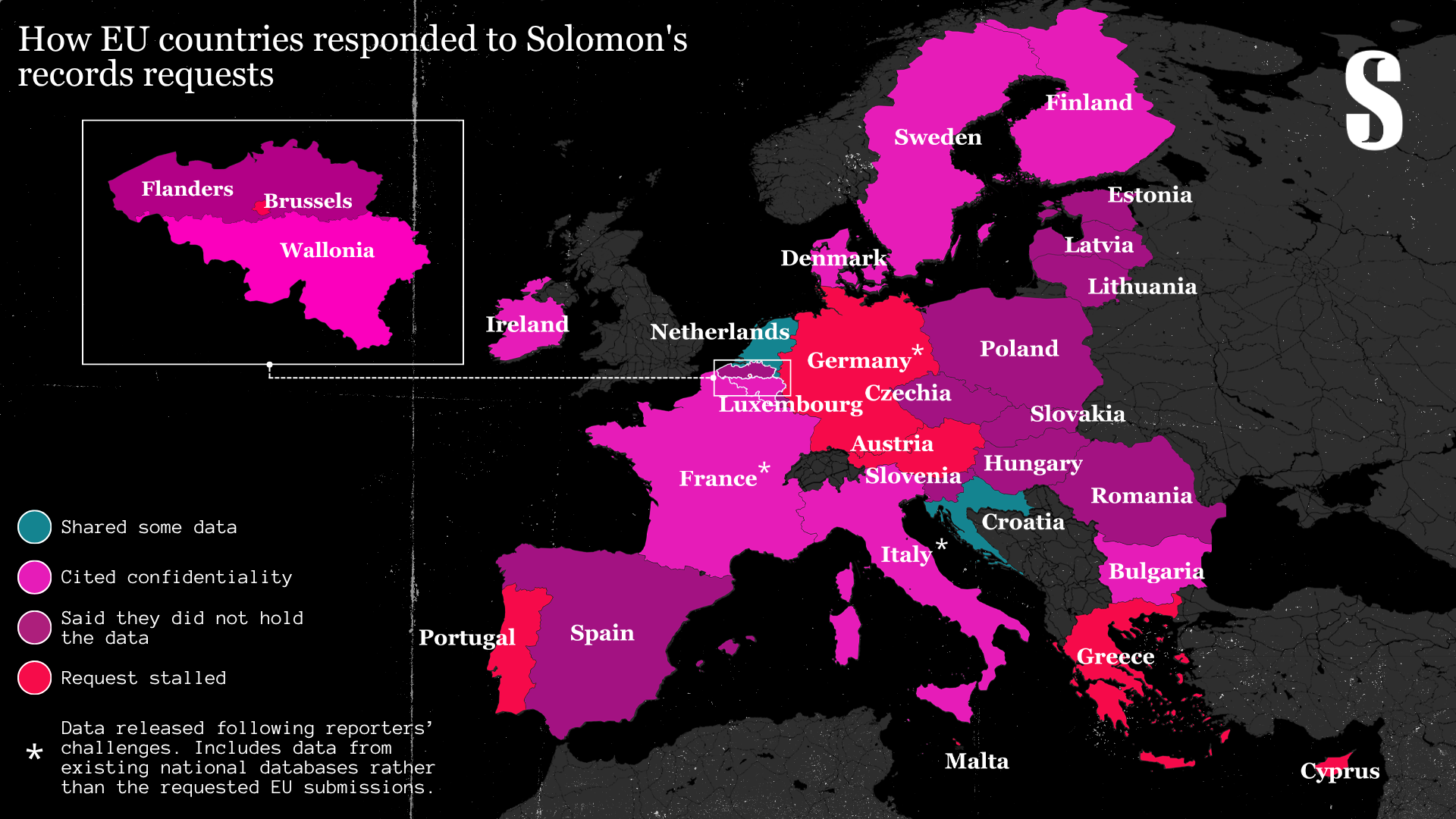
This investigation sought data centers’ consumption figures across all 27 EU countries. The requests, made under freedom of information and records laws, were met with refusals, delays and partial disclosures, as authorities offered different explanations for keeping the information out of public view.
Some governments cited commercial confidentiality. Others said they did not hold the data because operators reported directly to Brussels.
Ireland supplied correspondence with the Commission but withheld the underlying datasets, saying their “confidentiality is protected by law.” Cypriot officials described the information as confidential and commercially sensitive. In Sweden, a court ordered the energy agency to reconsider its refusal. The agency reviewed the request and again withheld the information on confidentiality grounds.
Other authorities said the data was in Brussels, despite EU reporting rules expressly giving member states access to submissions from data centers in their territories.
Czech authorities explained that operators submitted directly to the European database. Flemish officials gave a similar answer. In Denmark, the explanation changed: an initial refusal cited commercial interests; on review, authorities said they did not hold the data.
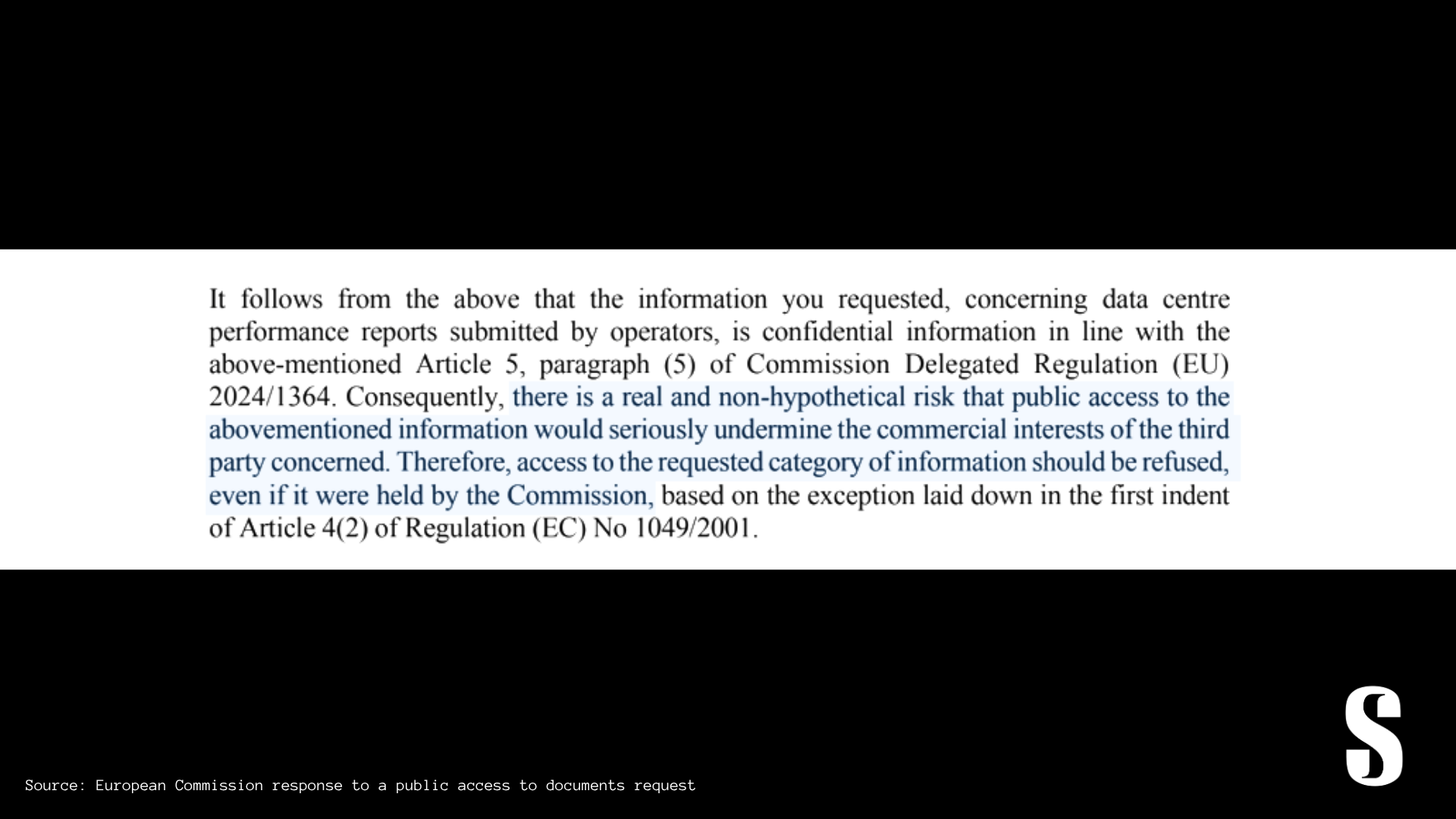
But when we approached the Commission itself, seeking records concerning facilities in four EU countries, it too refused to release the data. The Commission provided documents about how the system was being implemented but withheld the underlying consumption data, citing commercial interests. It upheld that refusal after an administrative appeal in June 2026.
The European Ombudsman has since opened an inquiry into the refusal following a complaint by reporters participating in this investigation.
Data disclosed, but distorted
Some national authorities did release data, exposing inconsistencies in how the confidentiality rules were applied. But disclosure did not always make the figures usable.
In France, following a challenge by our reporters, the country’s watchdog overseeing access to official documents, CADA, supported disclosure with safeguards against identifying individual facilities. The energy ministry removed names and addresses, then went further, shuffling values between rows.
An electricity figure could sit beside a water figure from an entirely different data center. We had the numbers, but could no longer reliably examine how energy and water use related to each other at a given facility.
German authorities took roughly nine months to provide a substantive response, eventually directing reporters to a public register established under national law. The register makes information about individual facilities public – precisely the kind of disclosure the Commission resisted on confidentiality grounds.
But the German register had gaps of its own. Our analysis could not identify entries for major US operators, including Digital Realty and Equinix.
What the Dutch numbers reveal
In the Netherlands, authorities released some facility-level data and published figures on their own dashboard, established under national legislation. Microsoft was among the operators that agreed to make their consumption figures public.
Those disclosures showed that secrecy was not universal. But transparency had its limits: this investigation found that nearly half the commercial data centers required to report were missing from the official register. Even among the 104 listed, fewer than half disclosed electricity consumption.
Official sources also gave conflicting accounts of the industry’s electricity use. Drawing on grid operators’ data, the national statistics authority calculated that data centers consumed 5.1 terawatt-hours of electricity in 2024 — equivalent to the annual consumption of nearly 2 million households. The Commission’s dashboard reported a substantially lower figure for the same year — just 17 percent of the total recorded by the Dutch statistics authority.
Van Veen, the technology policy expert, described the conflicting official figures as “disastrous” from a public policy perspective, “because you now don’t know which figures to trust.” Knowing how much energy the sector and individual facilities consume is essential to regulating them, he said. “Without that information, that becomes impossible.”
The discrepancy raised a question that extended beyond the Netherlands: how much of the industry’s consumption is the European system actually capturing?
The bigger they are, the less they report
Across Europe, much of the industry was missing from the database. The Commission’s own assessment found that only about 36 percent of data centers estimated to fall under the reporting requirement submitted information in the first reporting period, in 2024.
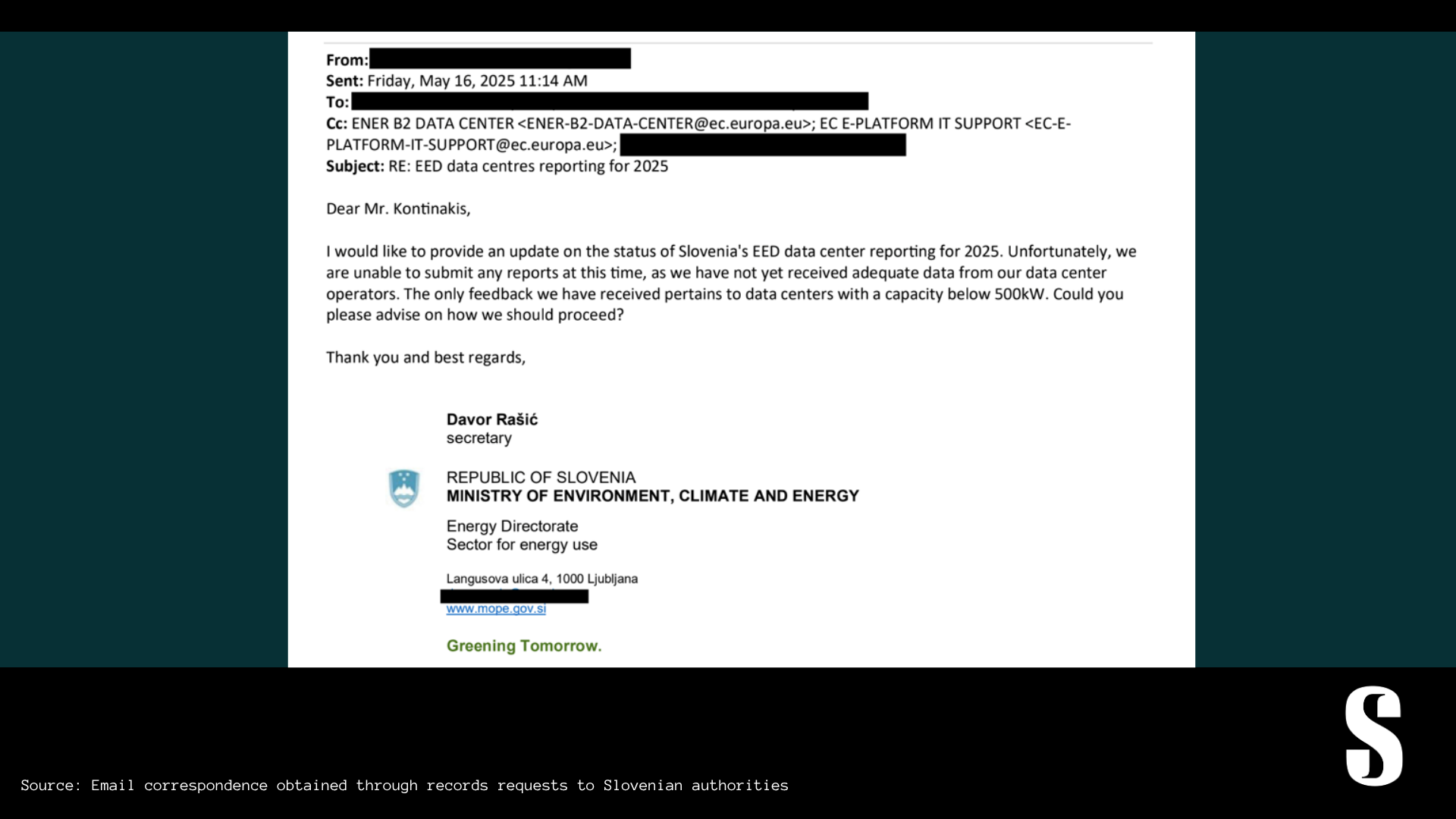
Correspondence obtained by this investigation shows the difficulties in getting operators to participate. In May 2025, Slovenia’s environment ministry wrote to the Commission that the only submissions it had received came from facilities too small to be required to report.
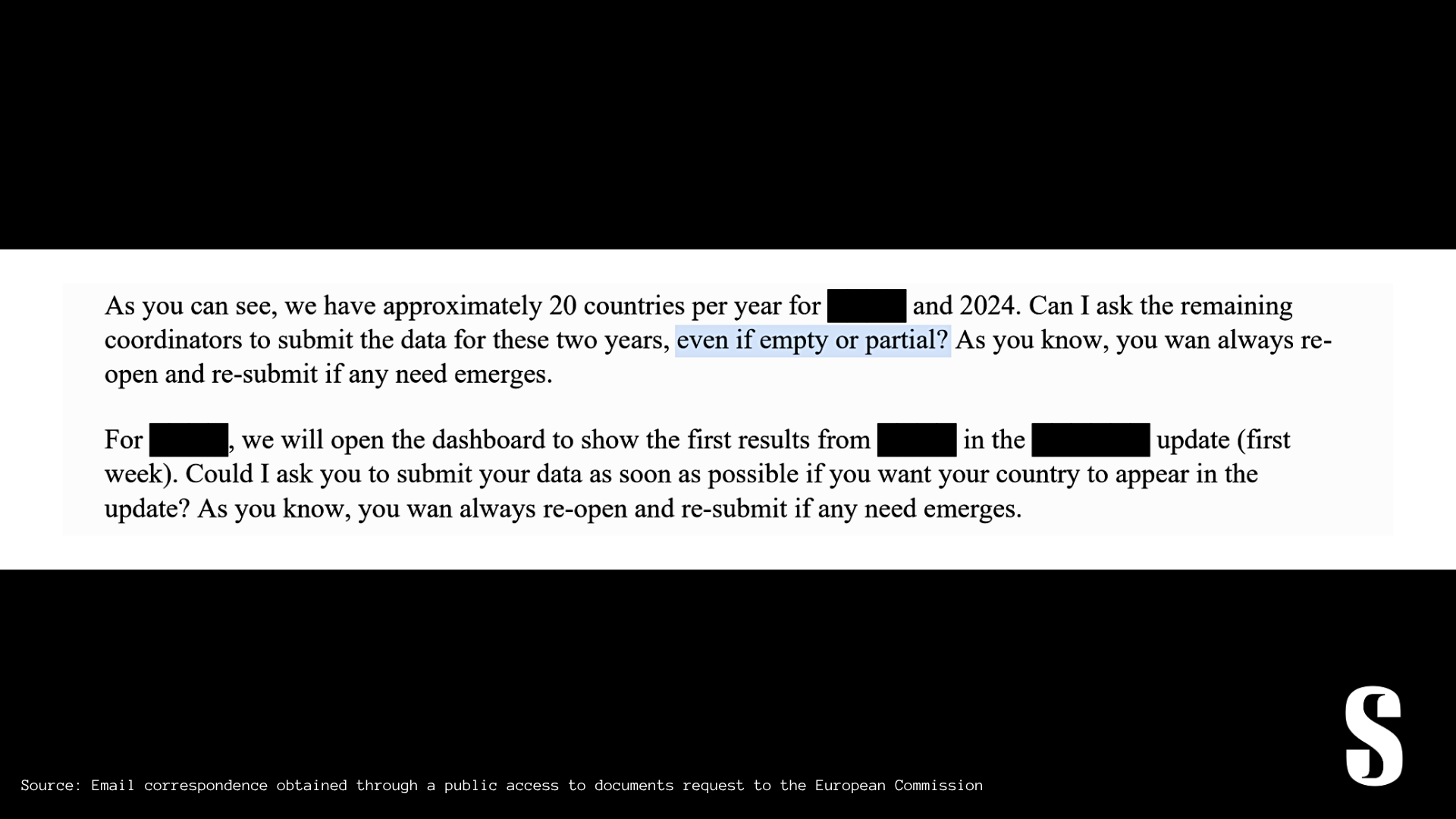
In other exchanges, Commission officials encouraged submissions “even with partial or no data,” so that more countries could appear on the public dashboard and update their figures later. A country’s presence on the dashboard did not necessarily mean it had supplied usable consumption figures.
The Commission’s public dashboard combines submissions into country-level consumption totals. These provide a partial picture of resource use, but do not reveal how much an individual facility consumes or how much pressure it puts on local supplies.
The gaps also make it difficult to track changes over time. The September dashboard update recorded fewer reporting facilities than the previous year, but roughly 25 percent more energy consumption and 50 percent more water use, according to our calculations.
Those increases might appear to show a sharp rise in consumption. But different facilities reported each year, so the totals cannot reliably show how the industry’s electricity and water use changed.
The Commission told this investigation that its initial priority had been to establish the register and that it was still assessing the quantity and quality of submissions. “As with every new reporting obligation, a phase-in period is needed,” it said in a statement, calling the database “the best evidence we have to date to discuss the sustainability of the sector.”
Greece’s incomplete picture
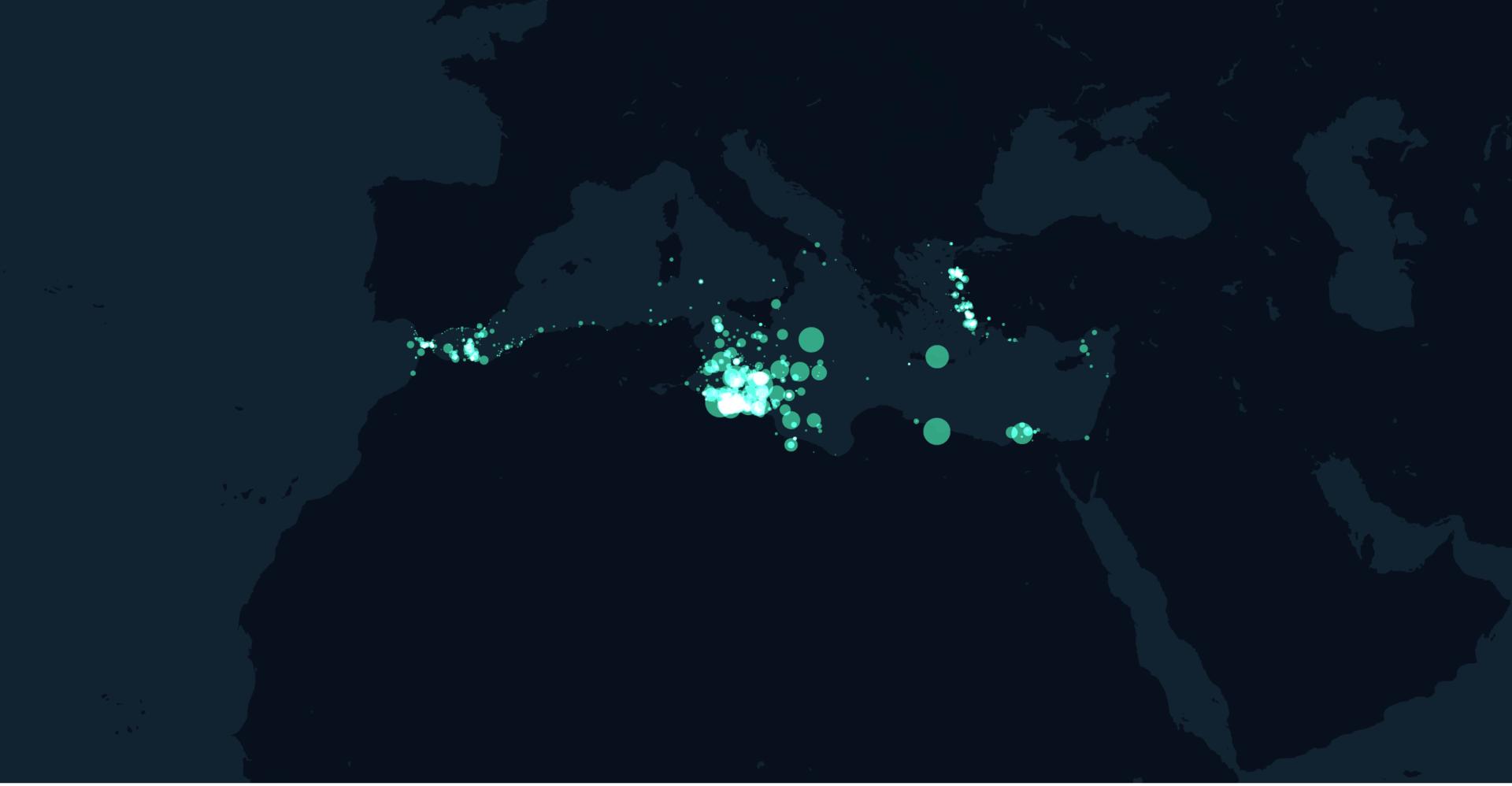
In Greece, the gaps in information coincide with plans for a dramatic expansion. Solomon’s previous reporting identified 21 operating data centers with a combined capacity of 44 megawatts. They consume around 65 gigawatt-hours of electricity a year — enough to power roughly 15,000 households, or the homes of a small city.
Most of Greece’s 21 operating data centers would fall under the Commission’s reporting requirement, yet the European dashboard lists only nine facilities.
Greek authorities have yet to provide the consumption figures requested by Solomon through a formal records request in October 2025.
At least eight additional projects with a combined capacity of 547.5 megawatts have secured grid connections. And another 30 applications, totaling nearly 3 gigawatts, remained pending as of this spring.
These findings form part of the first mapping of data centers across Greece, published alongside this investigation. It charts operating facilities and planned developments, showing the scale of the expansion.
Projects secured grid connections while crucial studies remained pending on whether electricity and water supplies could meet demand – and what the expansion would mean for electricity prices, Solomon found.
Residents seeking answers about developments near their homes also face gaps in environmental scrutiny.
In Christoupoli, a neighborhood in the Spata area near Athens, two data center projects beside residents’ homes have a combined capacity exceeding 20 megawatts – the threshold for a full environmental impact study under Greece’s permitting framework. But each falls below the threshold individually, so neither underwent a full environmental impact study.
A Microsoft facility slightly farther from the neighborhood did undergo an environmental impact assessment. Its permitting records state that no public comments were submitted during the consultation phase. Residents say they did not participate because they were unaware of the planned developments.
“They brought Microsoft in with great fanfare at a time when people didn’t know what a data center was, or what it meant for the environment – in terms of electricity and water consumption,” Ilias Gratsias, a local resident, told Solomon.
For residents like Gratsias, consumption figures from existing facilities would offer a way to test companies’ promises about new ones: how much electricity and water they might require, and what that could mean for them.
Alexandros Avlonitis, a PASOK member of the Greek Parliament representing Corfu, said his parliamentary questions about data centers’ environmental footprint had yielded no consumption figures or copies of the studies authorities cited.
“We are all being kept in the dark,” Avlonitis said. “We are not opposed to data centers in principle … We oppose the installation of data centers without knowing what we are getting into.”
Challenging the secrecy
This investigation has now moved beyond requests for records to a challenge to the rules keeping them secret.
Filed this week, the legal challenge asks the body overseeing compliance with the Aarhus Convention to find that the EU has breached its obligations to provide access to environmental information. It challenges both the rules treating individual data centers’ submissions as commercially confidential and the Commission’s use of those rules to refuse disclosure.
The Aarhus Convention has been used to help force disclosure of records relating to Volkswagen’s emissions scandal: in 2019, a German court ordered the release of investigation records, rejecting claims of commercial secrecy.
The complaint, authored by Lighthouse Reports, argues that the Commission failed to weigh the public interest in releasing the information or consider whether parts of the records could be disclosed.
“We do not think this wall of silence has arisen by accident,” the submission states, pointing to a “clear and consistent determination among policy makers across the European Union to deny or deter access to, and obfuscate understanding of, how data centres are performing and the environmental impacts they are having.”
“If the Commission has decided, as they have done, to shelter the sector by giving them a very generous confidentiality exemption,” said van Veen, the technology policy expert, “then it’s the role of journalists and the role of public interest organizations and others to call for more transparency.”
Asked to comment on the submission, Greek MP Avlonitis said, “Energy and water consumption are not commercial secrets. Citizens need energy and water in their daily lives; they do not need promises of efficiency.”
** This story is part of the “Data Centre Silence” investigation led by Lighthouse Reports, in collaboration with Solomon (Greece), Mediapart (France), El Confidencial (Spain), Il Manifesto (Italy), and Trouw (Netherlands).