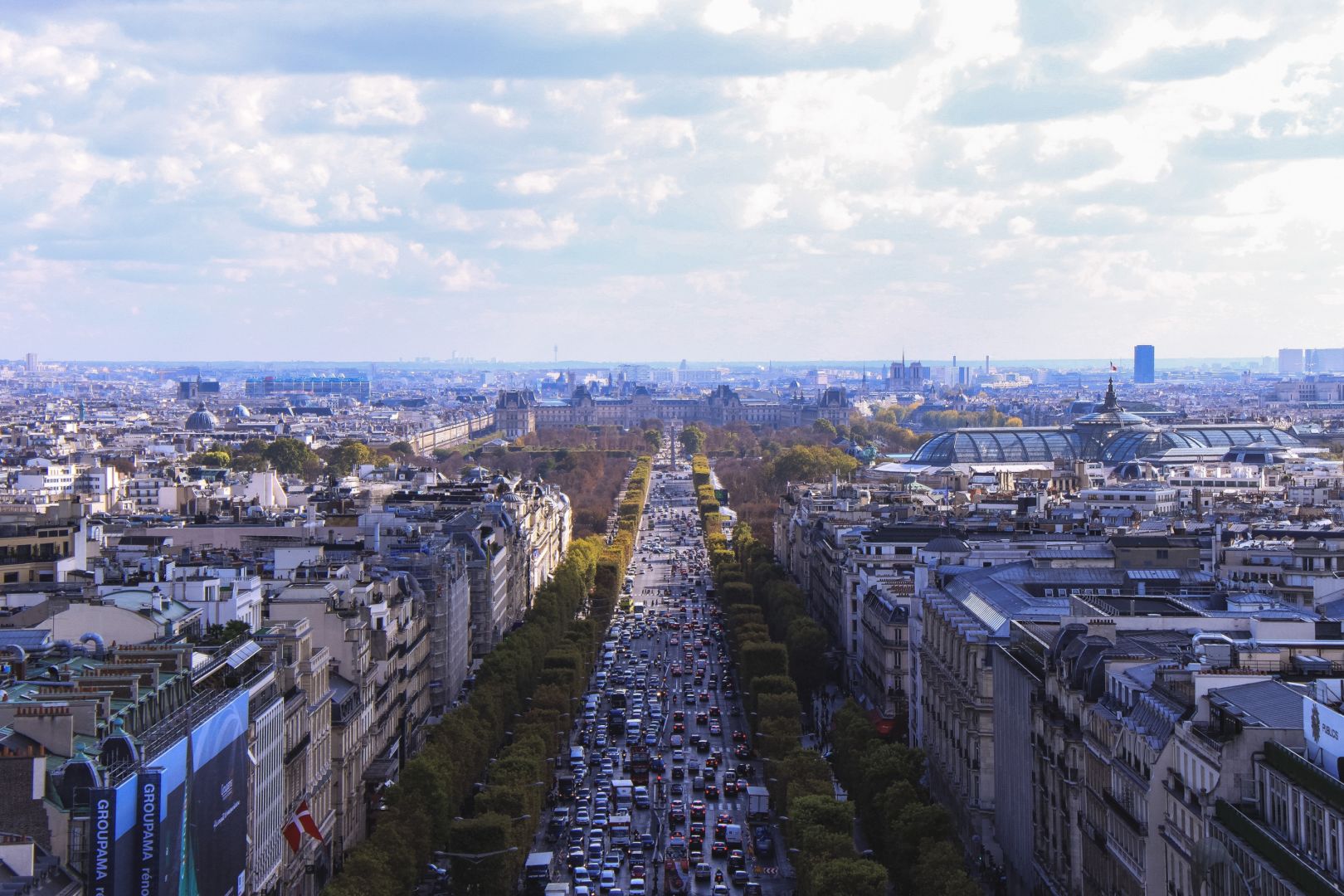
Every minute, a building in Europe is demolished. The EU has no record of it.
Across the European Union, buildings are disappearing at an astonishing rate — roughly one every minute, according to independent researchers. Yet the bloc has no official record of what is being lost, even as it pledges to curb demolitions and promote renovation.
Across the European Union, buildings are disappearing at an astonishing rate — roughly one every minute, civil society researchers estimate. Yet the bloc has no official record of what is being lost.
Despite its ambitions to curb demolitions and their toll on the environment and housing, the European Commission admits it has no central record of what is being torn down.
An investigation by Solomon and Correctiv.Europe, part of the cross-border Demolition Atlas project, found that most European countries lack national databases of demolitions.
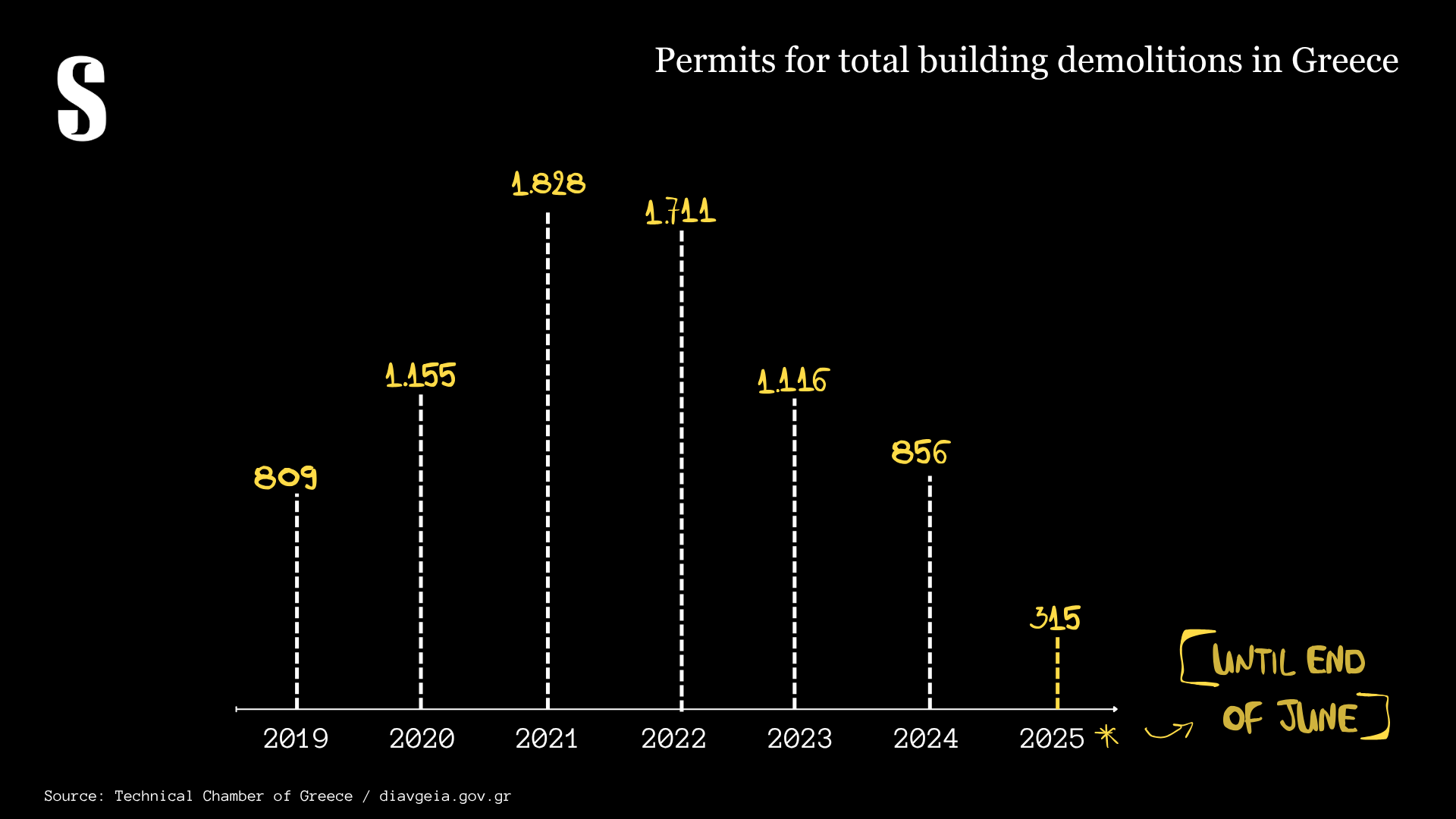
Greece is a rare exception: its urban planning authorities are required to publish demolition permits on the public transparency platform Diavgeia. But transparency hasn’t translated into a clear strategy for managing demolitions — if anything, current incentives make tearing down easier and more appealing than preserving.
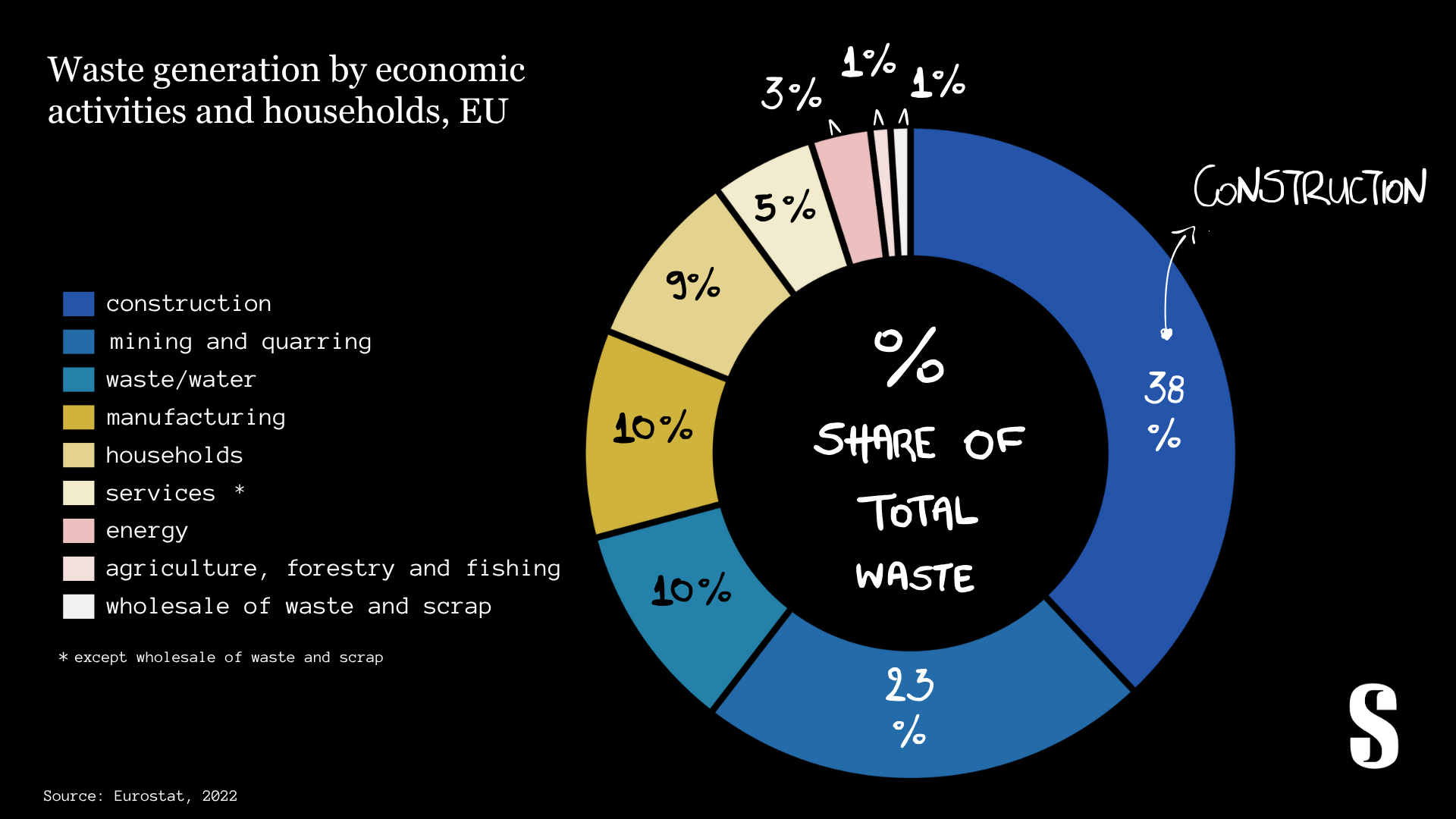
Elsewhere, the picture is murkier, and that data gap matters. Nearly 40 percent of the waste produced in the EU comes from construction and demolition, making the sector one of Europe’s largest sources of emissions and environmental impact.
Without reliable figures, experts warn, the Union’s flagship plan to reduce demolitions through a continent-wide “renovation wave” may be building on shaky ground.
The EU has goals but no data
For years, European officials have vowed to make the construction sector greener and more efficient. But when it comes to tracking how much of the continent’s built environment is being destroyed, the bloc has little to go on.
“The construction sector is deepening both the climate crisis and Europe’s housing crisis,” said Ciarán Cuffe, co-chair of the European Green Party (EGP). “Too many buildings are demolished for no reason. If we renovated them instead of tearing them down, they could still be homes for people.”
When asked what data exist on demolitions across the bloc, the European Commission conceded there are none.
“Currently there is no official EU-level data for the number of buildings demolished, overall or by type” a Commission told Solomon in a statement.
National construction statistics track building permits, not demolitions. And even in countries that keep registries, those databases focus on existing structures rather than the ones that have vanished. France and Germany, for example, maintain national building inventories, but only the German state of Berlin keeps a specific demolition record.
The data gap extends further: the Commission said it also lacks information on the waste generated by demolitions in each member state, since most countries lump construction and demolition waste together.
Europe’s waste problem
Every demolition leaves behind mountains of rubble and a growing environmental burden. The EU has pledged to make the construction industry more sustainable by reducing waste, conserving materials and cutting emissions. When demolition waste can’t be avoided, the goal is to turn it into a resource, and to recycle more of it.
So far, though, Europe is struggling to measure the damage, let alone contain it.
In 2022, the bloc generated more than 2.2 billion tons of waste, according to Eurostat. Nearly 40 percent came from construction and demolition, making it one of Europe’s most polluting sectors.
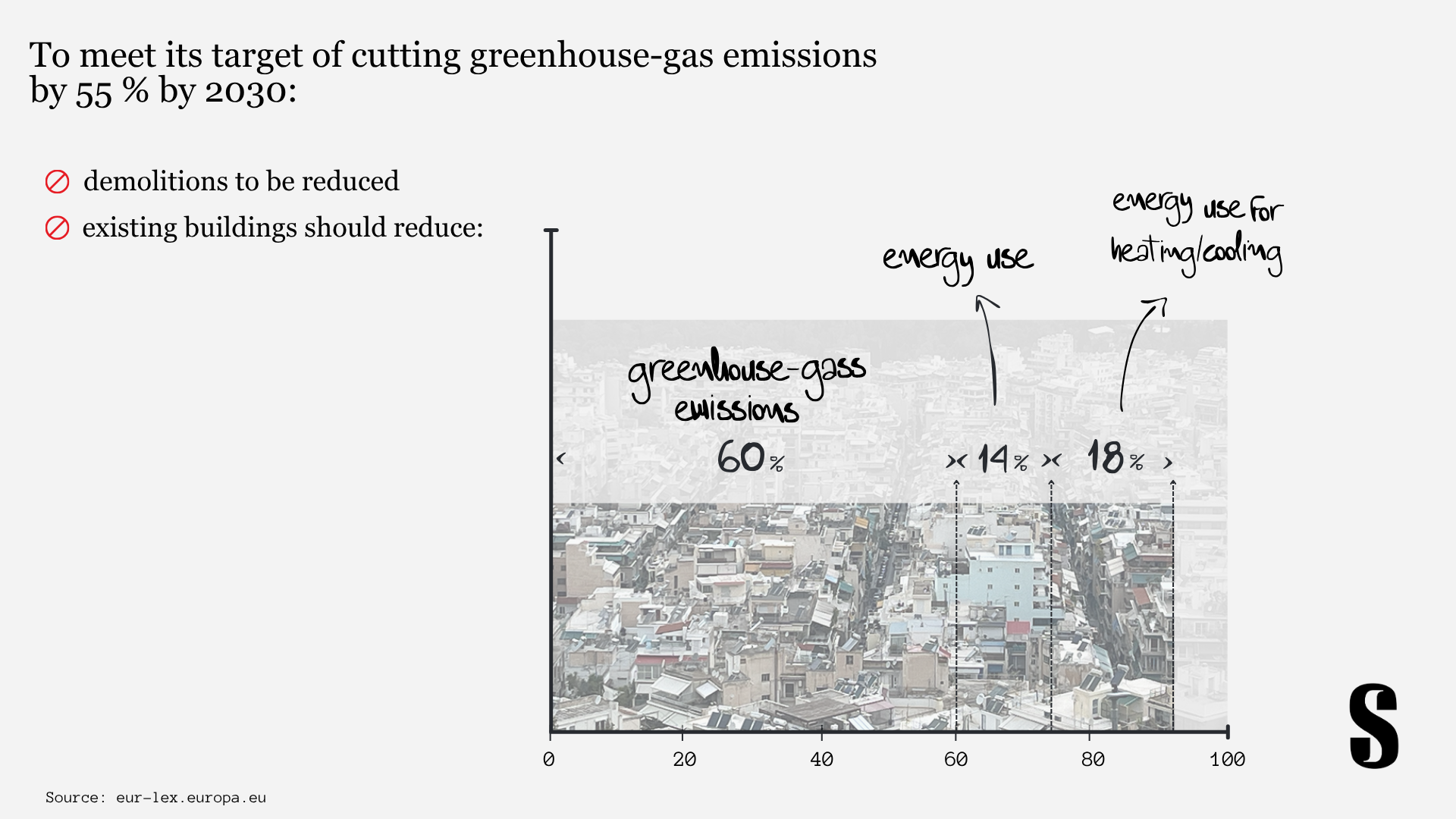
Buildings themselves account for more than a third of the continent’s carbon emissions, through both the energy they consume and the materials used to make them. To meet its target of cutting greenhouse-gas emissions by 55 percent by 2030 (compared to 1990), the EU says the construction sector must reduce its own emissions by 60 percent and curb energy use for heating and cooling.
Europe’s answer: a ‘Renovation Wave’
Brussels’ plan to achieve that hinges on what it calls a “Renovation Wave.” Introduced in 2020 as part of the European Green Deal, the strategy aims to double the annual rate of building renovations by 2030, retrofitting 35 million structures and creating jobs in the process.
It is also linked to the New European Bauhaus, a design and cultural initiative inspired by the early-20th-century movement that sought to unite beauty, function and social purpose. The modern version promotes sustainability and inclusion, urging architects, planners and policymakers to rethink how people live and what kind of communities Europe builds next.
But experts warn that without reliable data on what is being demolished—and why—Europe’s renovation goals risk becoming another green promise built on shaky ground.
Architecture meets the market
Across Europe, architects and preservationists are calling for a shift in mindset: to value renovation over replacement, and to treat existing buildings as cultural and environmental assets.
Kostas Tsiambaos, an architect and associate professor at the National Technical University of Athens, said that modern architectural thinking internationally favors preserving existing building stock over erecting new structures. But in Greece, he added, market forces are pushing in the opposite direction.
“Buildings and constructions are treated as investment products,” he said, “and many foreign investors have entered the Greek market — something that wasn’t the case until recently.”
That influx is reshaping cities across southern Europe, where rising land values and speculative development have accelerated the demolition of older buildings. Small houses and mid-century structures are increasingly torn down to make room for new apartment blocks and short-term rentals.
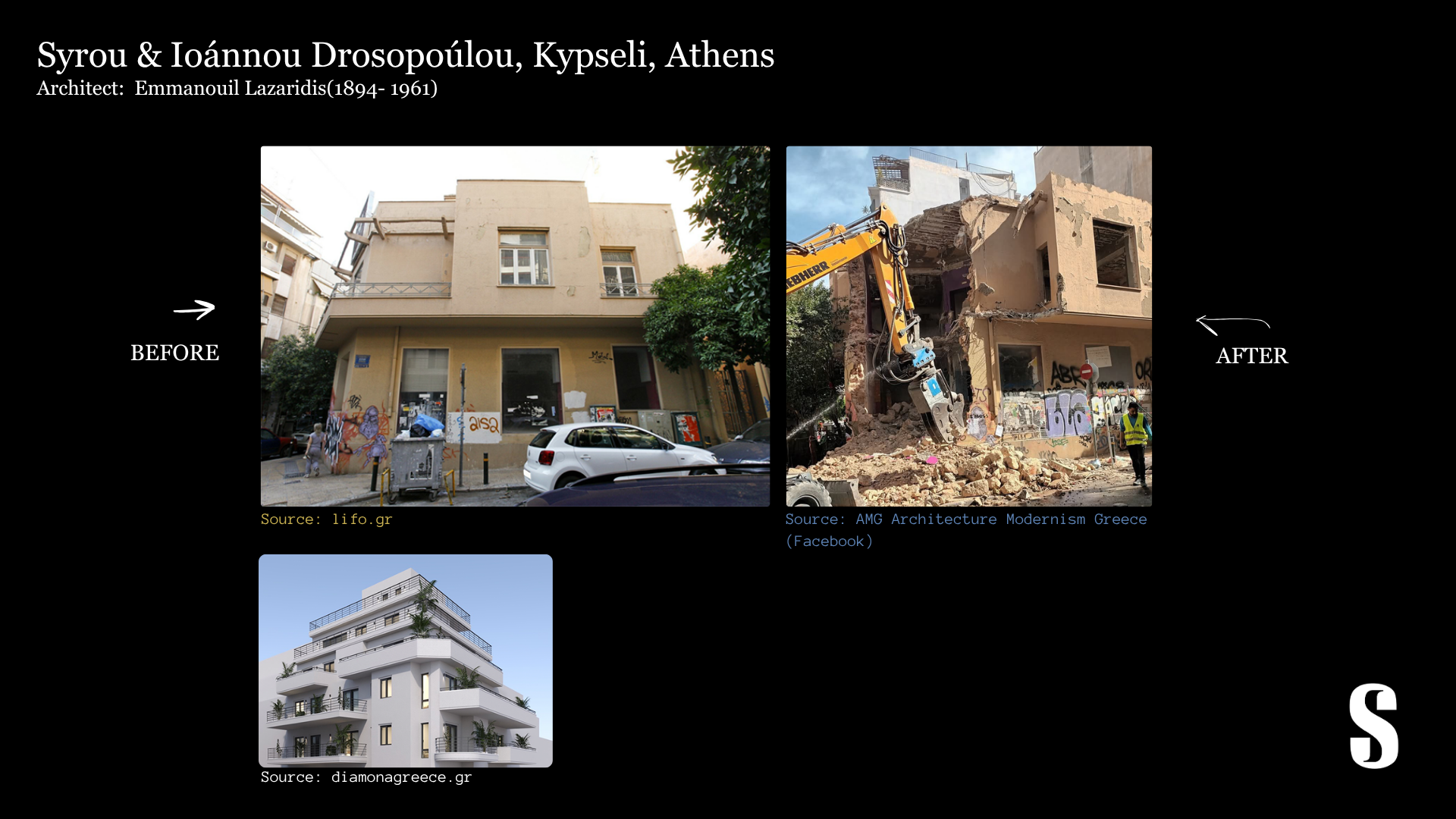
A case in point is a two-story modernist home in central Athens, built in 1935 and recently demolished to make way for a luxury residential complex. As first reported by Solomon, the project was developed by Diamona Greece, a company backed by Israeli investors. The firm is among several foreign-owned developers transforming the city’s housing landscape.
Similar transformations are unfolding across the continent, where demolition has become both a symbol of progress and a measure of how easily memory can be traded for profit.
A Push to Renovate, Not Demolish
In Berlin, the nonprofit HouseEurope! is campaigning for new European laws that would protect both affordable housing and the climate.
Between 5 and 15 percent of Europe’s existing buildings could be demolished by 2050, the group estimates — about 1,400 a day.
“Every minute, one building in Europe is demolished,” it warns, citing projections from the European Environment Agency.
Its message is simple: say no to demolitions, and yes to renovations. The group’s architects and activists argue that preserving homes saves energy, resources and communities, and keeps people connected to their shared histories.
“If we agree that more renovations are needed, they shouldn’t come at the expense of the people who live there,” said Olaf Grawert, a HouseEurope! member and architect. “That requires political will and the right laws.”
Grawert recalled a conversation with a construction executive at a housing conference. He had asked why the company preferred to demolish buildings rather than renovate them. The executive replied that demolitions were simply easier.
“Would you demolish your parents’ house?” Grawert recounted asking. “Of course not — my father would be devastated.”
“Then why demolish someone else’s?” he said.
The Greek case
In Greece, most demolitions fall into two categories: old industrial sites left vacant for years, and single-family homes torn down to make way for multi-story developments.
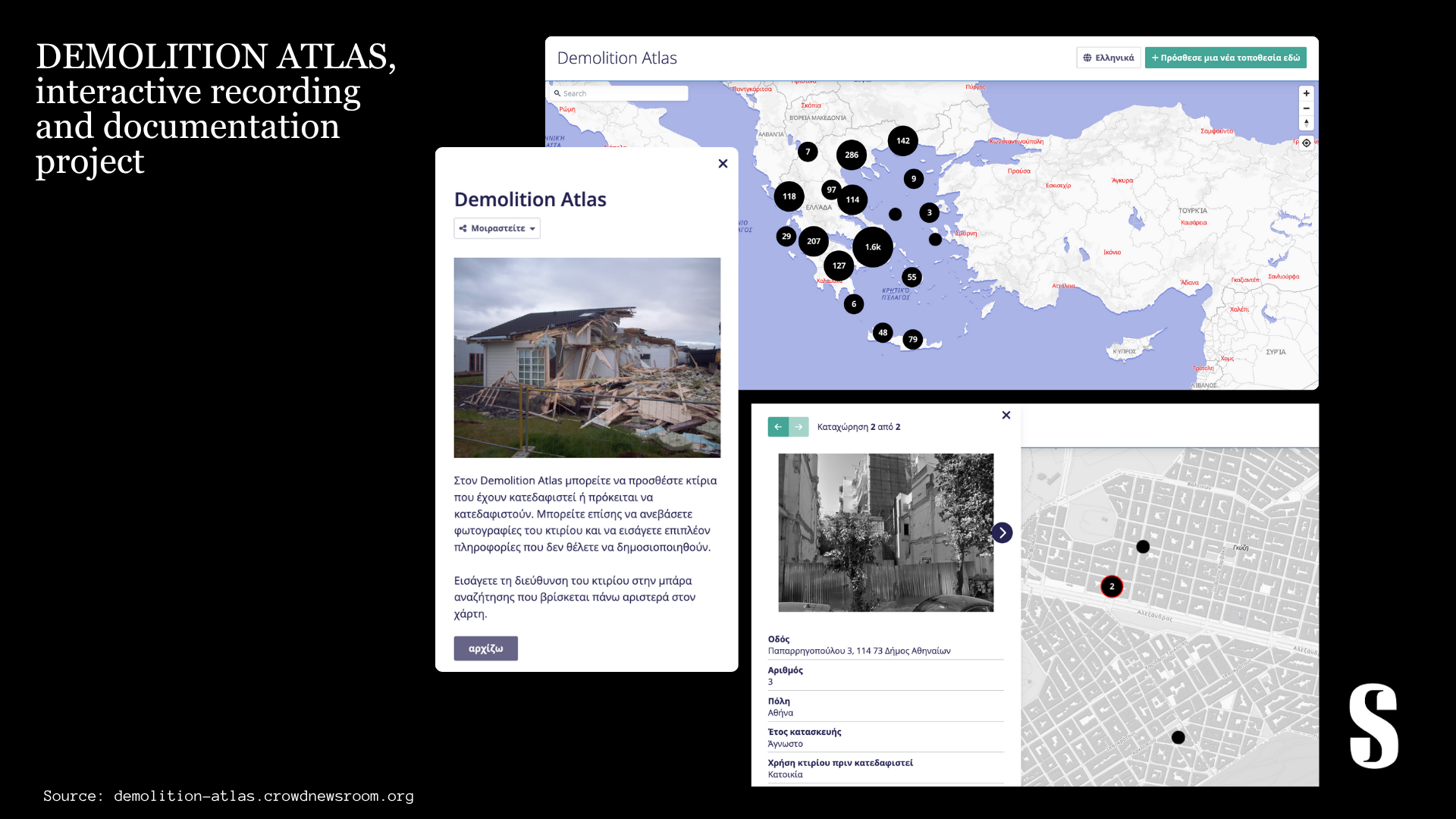
As part of the Demolition Atlas project — an interactive platform where anyone can submit data on torn-down buildings — Solomon recorded nearly 8,000 demolition permits issued across Greece between 2019 and June 2025. Athens ranked first, with about 500 demolitions, followed by Thessaloniki with 166.
Marietta Fournaraki, an architect with Bobotis+Bobotis Architects, said that not all demolitions can be avoided.
“There are many derelict buildings that have to be demolished for safety reasons,” she said. “If the necessary attention had been given earlier, we wouldn’t have reached that point.”
According to Fournaraki, Greece has only recently begun to take environmental factors into account — mostly in large commercial development projects. She said that ultimately it’s up to investors to decide whether they’ll pay more to be environmentally responsible, and that more incentives are needed for sustainable construction.
She also noted that renovations are roughly three times more expensive than new construction, which discourages owners from preserving old buildings.
“There’s also the argument that we need more housing,” she said. “So why keep one small house when you can build apartments for twenty families? But even those new apartments rarely end up housing local families. They’re bought by digital nomads earning three times as much.”
The “enormous political cost” of preservation
For Τsiambaos, the architecture professor, the fight over demolitions isn’t only about architecture; it’s about memory, ownership and politics.
“We can’t afford to lose the memory, the history of the city,” he said. “If there’s nothing left standing from before 1950, it will be nightmarish. A large part of the 19th century has already disappeared, and if we also lose the memory of the first half of the 20th, what will remain of the past?”
He said that in Greece it is hard to design public policy that limits demolitions because of the country’s deeply fragmented system of small-scale ownership.
“What’s always difficult — and carries enormous political cost — is telling someone what they can or can’t do with their own property,” he said. “Telling them, for instance, that they can’t demolish a building they might have hoped to use to improve their living situation or leave something to their children.”
Τsiambaos grew up in the Athens neighborhood of Pangrati, where he remembers streets once lined with single-story homes from the 1920s and ’30s. Today, only a few remain. “The change is enormous,” he said. “There have been several waves of replacement of old housing stock — before the Athens Olympics, for example — but in recent years there’s been an explosion of demolitions and new permits.”
He believes architects and engineers have a responsibility to show that older buildings can be modernized without losing their character.
“We shouldn’t always choose the quick, easy solution,” he said. “New buildings are, as a rule, of much poorer quality. They may be modern, but they’re often made with cheap materials, cramped layouts and low ceilings.”
In Greece, the environmental cost of demolitions has yet to enter public debate, said Maria Peteinaki, an architect and member of Architects Climate Action Network Greece, a coalition of professionals pushing for climate justice in architecture and construction.
She explained that every demolition must include a waste management plan, which in theory ensures that rubble is recycled and reused. But in practice, she said, confidence in recycled materials remains low — and even those who want to use them rarely can.
“Whatever is recycled usually ends up in public works, like road construction,” Peteinaki said. “There are no available materials for private use, even for people who might want to use them.”
The European Commission noted in 2018 that while most construction and demolition waste could be recycled, the lack of confidence in its quality remains a major obstacle. Today, that problem persists in Greece.
Peteinaki said there are still no real incentives to preserve existing buildings.
“It’s the opposite,” she said. “There’s no financial incentive for renovations, only for new construction.”
Under Greek law, property owners receive a bonus in building capacity when they demolish a structure — an incentive that continues to make tearing down easier, faster and more profitable than preserving what already exists.
A future without a past?
At Greece’s Ministry of Culture, officials say their policy is clear: preserve as much as possible.
Amalia Androulidaki, head of the ministry’s Directorate for Restoration, Museums and Technical Works, said that monuments and “modern heritage” buildings are never demolished — except in cases where they are structurally unsound. Even then, the aim is to stabilize and restore them whenever possible.
The ministry’s approach aligns with the New European Bauhaus, the EU initiative that promotes restoration and the reuse of existing structures. In Athens, the ministry has already approved several projects under this framework — many of them conversions of old office buildings into hotels downtown.
The next challenge, Androulidaki said, will come within a decade, when the country’s interwar apartment buildings — those built in the 1930s and ’40s — will cross the 100-year mark and become eligible for protection. Many of them were made of reinforced concrete, which by then may no longer be structurally sound.
“For now, there is concern and ongoing research into the issue, focusing on the use of innovative materials,” she said.
Androulidaki acknowledged that preservation is rarely simple. Investment pressures are strong, and Greece’s new building code, which rewards higher-density development, makes demolition tempting.
Without a long-term plan, experts warn, the next decade could bring another wave of demolitions, erasing not just homes but the physical memory of the modern Greek city.
Τsiambaos said that the pace of redevelopment demands a clear, long-term plan — one that defines how Greece wants its cities to evolve.
“This situation needs proper planning,” he said. “For example, a policy that sets out what should happen over the next decade — and then is followed through.”
“Of course,” he added, “in ten years there may be nothing left.”
The journalistic investigation Demolition Atlas by Solomon, in collaboration with Correctiv.Europe, is carried out with the support of JournalismFund Europe.