How Santorini became Royal Caribbean’s test case for bringing the Bahamas private destination model to Europe
One of the world’s largest cruise companies is bringing its private destination model to Europe and reigniting the debate over who really benefits from cruise tourism.
Every few minutes, another tender boat noses in Santorini’s old harbor. Every few minutes, the same question rings out across the dock.
“Is this the line for the cable car?”
It’s the morning of July 21, one of the hottest days of the summer, and nearly 7,000 cruise passengers have arrived aboard three cruise ships anchored below the island’s volcanic cliffs. Some wait in long queues for the cable car to Fira, the island’s capital. Others begin the climb up 587 stone steps carved into the cliff. A few ride donkeys up the winding path, despite years of criticism from animal welfare groups.
Not everyone, however, is heading into town.
When they reach Fira, coach buses wait to collect passengers who have already paid for a different kind of day on Santorini – one that will unfold almost entirely beyond the island’s restaurants, cafés and shops.
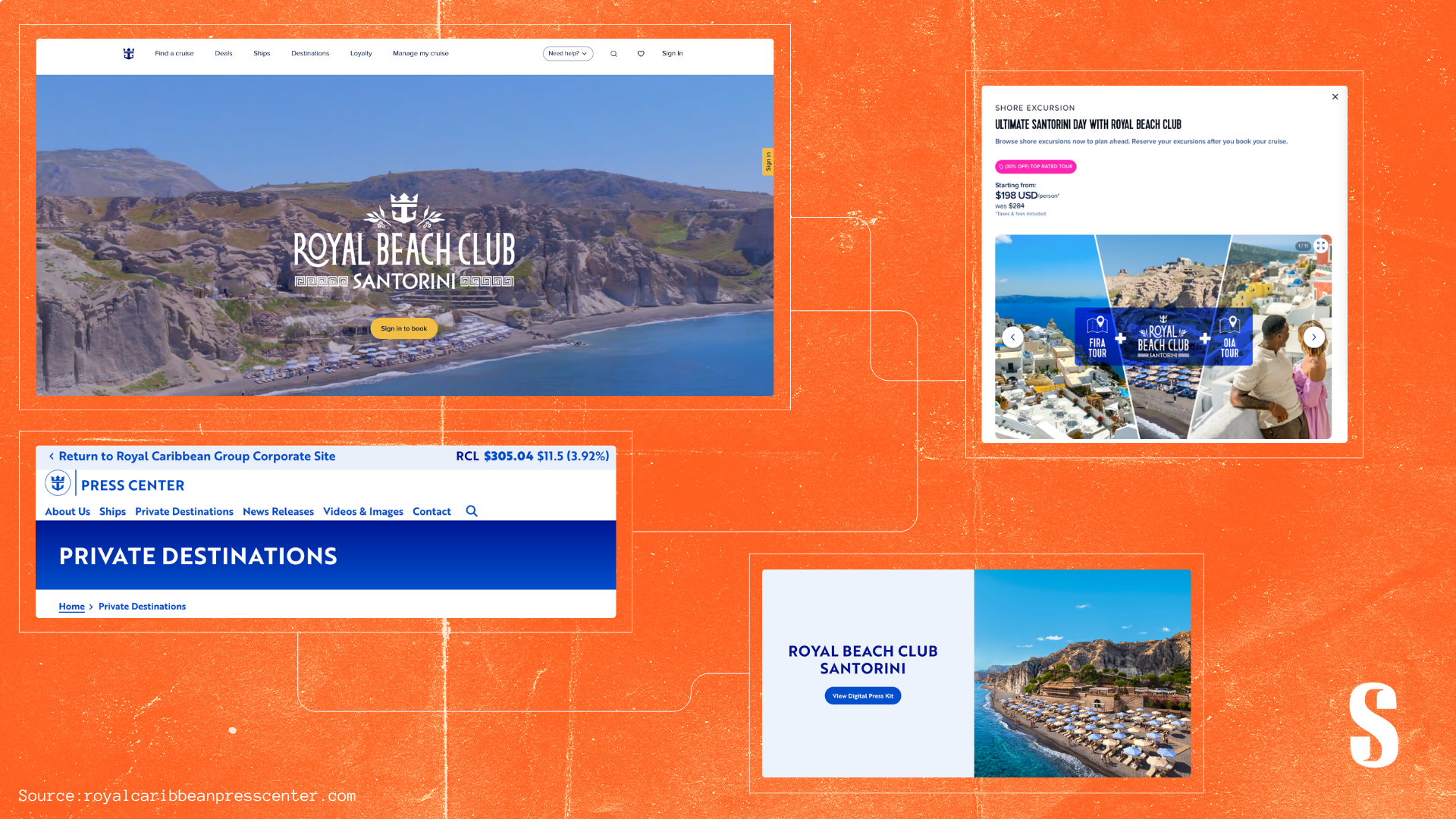
Their destination is Royal Beach Club Santorini, a private beach club opened this spring by Royal Caribbean Group, one of the world’s largest cruise companies. Instead of encouraging passengers to explore the island independently, the company shuttles them between its all-inclusive seaside resort, company-organized excursions, and the ship, as part of a tightly managed itinerary.
For Royal Caribbean, the venture represents the European expansion of a strategy it has spent years refining elsewhere.
For many on Santorini, it represents something else entirely.
According to Solomon’s analysis, nearly one million cruise passengers are expected to visit Santorini between April and December this year – more than 60 times the island’s permanent population of about 15,000. Roughly one in three will arrive aboard ships operated by Royal Caribbean Group.
For years, residents have debated whether the economic benefits of cruise tourism justify the strain it places on the island’s roads, public spaces and infrastructure.
Royal Beach Club has sharpened that debate by raising a new question: If cruise companies increasingly control where passengers eat, drink and spend their time ashore, how much value is left for the destinations they visit?
Europe’s first Royal Beach Club
It is just after 6 p.m. when staff at Royal Beach Club Santorini begin preparing for the arrival of passengers from Odyssey of the Seas. Seven coaches, each carrying around fifty people, are expected within minutes.
On its website, Royal Caribbean describes the venue as “Europe’s first” and promises guests “the easiest way to enjoy the best of the island.”
For around $200 (approximately €175), passengers receive a three-and-a-half-hour all-inclusive visit that includes transportation, food, drinks, beach access and entertainment. “Everything you need is already taken care of,” the company tells prospective guests.
The beach club is part of a broader shift in Royal Caribbean Group’s business strategy.
Headquartered in Miami, Florida, the company operates seven cruise brands and says it has welcomed more than 100 million passengers since its founding. In 2025, it reported total revenue of $17.9 billion (€15.75 billion) and net income of $4.3 billion (€3.79 billion). Over the past three decades, it has also faced multiple criminal and civil environmental enforcement actions in the United States, including guilty pleas for illegal discharges of oily waste and falsifying pollution records in the late 1990s, as well as a 2024 settlement with the U.S. Environmental Protection Agency over hazardous waste management and reporting requirements.
For years, cruise companies have competed by building larger ships and adding more attractions on board. Now they are increasingly investing in the destinations themselves.
Royal Caribbean Group is among the companies leading that shift. It operates a growing collection of private islands, exclusive beach clubs and branded shore experiences designed to keep passengers within its own ecosystem after they disembark. In its latest annual filing with the U.S. Securities and Exchange Commission, the company says its Royal Beach Clubs are designed to offer guests “an exclusive and branded experience at high volume ports.”
Santorini is the first European test of that model. Cruise industry sources told Solomon they were unaware of any comparable facility operated by a major cruise line elsewhere in Europe. Royal Caribbean already operates or plans similar destinations in the Bahamas, Mexico and the South Pacific. In effect, the company is extending the all-inclusive experience onto land.
“Negative impact on the local community”
What makes Santorini different is not the concept, but the setting. Unlike the company’s private destinations elsewhere – which are purpose-built for cruise passengers, such as CocoCay in the Bahamas – Santorini is one of Europe’s most famous tourist destinations, with an economy built around independently owned hotels, restaurants, wineries, shops and tour operators.
Three months after the beach club opened, the Municipality of Thira said it had been monitoring its impact on the island’s broader tourism economy.
In a written response to Solomon, the municipality said that dispersing visitors across the island creates significant benefits both for local businesses and for visitors’ own experience. By concentrating passengers inside a single private venue, it concluded, the private facility has had “a negative impact on the local community and economy.”
Solomon requested Royal Caribbean Group’s comment on concerns raised by local officials and businesses regarding the Royal Beach Club and its impact on Santorini’s local economy. The company did not respond by the publication deadline.
The municipality has opposed the project from the outset.
In October 2025, months before the beach club opened, Santorini’s municipal council formally declared its opposition to the creation of what it described as a “closed” facility or any area reserved exclusively for passengers of a cruise company.
Royal Caribbean later announced that local residents would also be able to purchase tickets – subject to availability – on days when one of its ships is in port. Admission costs €118 for adults, and €62 for children aged 12 and under.
Mayor Nikos Zorzos remains unconvinced.
“[Royal Caribbean] brings visitors to Santorini and takes them to its own private facility, where the company – and not the local community – captures most of the economic benefit,” he told Solomon.
The mayor says the municipality is considering introducing a system of negative scoring that would reduce berth-allocation priority for cruise lines operating similar models, giving preference to companies whose passengers contribute more broadly to the island’s economy.
For Royal Caribbean, the beach club is a premium shore excursion. For Santorini, it has become a symbol of a larger debate over the future of cruise tourism.
An island under pressure
The controversy over Royal Beach Club comes at a time when Santorini is struggling to cope with the sheer scale of cruise tourism.
For decades, the island has been one of the Mediterranean’s most sought-after destinations. But the rapid growth in visitor numbers has forced local authorities to confront a difficult balancing act: how to preserve the economic benefits of tourism while preventing the island from being overwhelmed by it.
A 2017 report by the Santorini Tourism Observatory of the University of the Aegean estimated that, during the high season, the island could receive up to 18,000 cruise passengers a day in peak periods.
In 2018, Santorini introduced a daily cap of 8,000 cruise visitors. The limit was later abandoned, and by 2023 there were 63 days when arrivals reportedly exceeded 10,000 passengers. The cap was reinstated in 2025.
Today, cruise arrivals are managed through a berth allocation system that limits the number of cruise ships allowed to visit the island each day. “Before berth allocation was introduced, the situation was completely uncontrolled,” Mayor Nikos Zorzos said. “Ships arrived whenever they wanted, on whichever days they wanted, and unloaded as many passengers as they wanted.”
Since 2025, passengers disembarking in Santorini and Mykonos during the summer have also paid a €20 fee introduced by the Greek government to help address the pressures created by mass tourism. From the revenue generated by this levy, the Municipality of Thira received €3.35 million for 2025 and a further €320,000 for the first five months of 2026, with the funds earmarked for infrastructure projects, according to the mayor’s office.
This year, the municipality added another measure. Under what has become known as the “70-30 rule,” seventy percent of cruise passengers are directed through Fira’s old harbor, while the remaining thirty percent arrive via the commercial port of Athinios in an effort to spread visitor flows more evenly across the island.
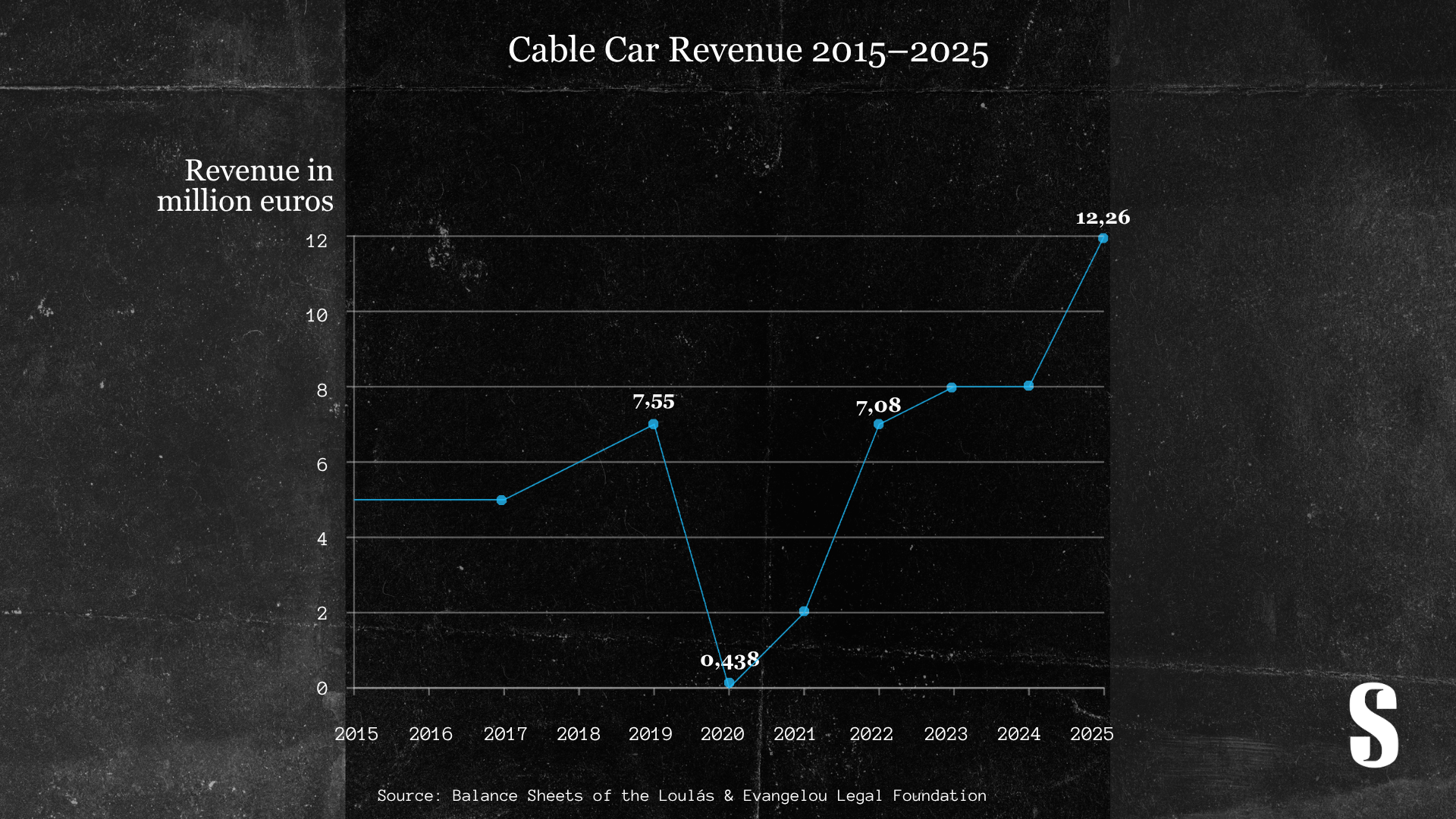
The policy has further increased the importance of the cable car. Built in 1982 through a private donation to the municipality, it is the main route connecting Fira’s old harbor with the town above. During the cruise season, it has become both one of the island’s most valuable assets and one of its biggest bottlenecks. The ride takes just three minutes, but during the summer passengers often wait in long lines under the sun before boarding. At the same time, the cable car has become a major source of revenue. In 2025, it generated more than €12 million, according to the financial statements of the Loula & Evangelos Nomikos Foundation, which operates the system.
Cruise industry representatives have criticized the 70-30 policy, arguing that directing such a large share of passengers through the old harbor creates bottlenecks at the cable car. Speaking in June, Bud Darr, president and CEO of the Cruise Lines International Association (CLIA), the world’s largest cruise industry trade association, warned that “this is not just an inconvenience … this is also now becoming a safety issue.”
The debate reflects a broader challenge facing Santorini. Despite a series of measures aimed at managing visitor flows, cruise tourism continues to grow.
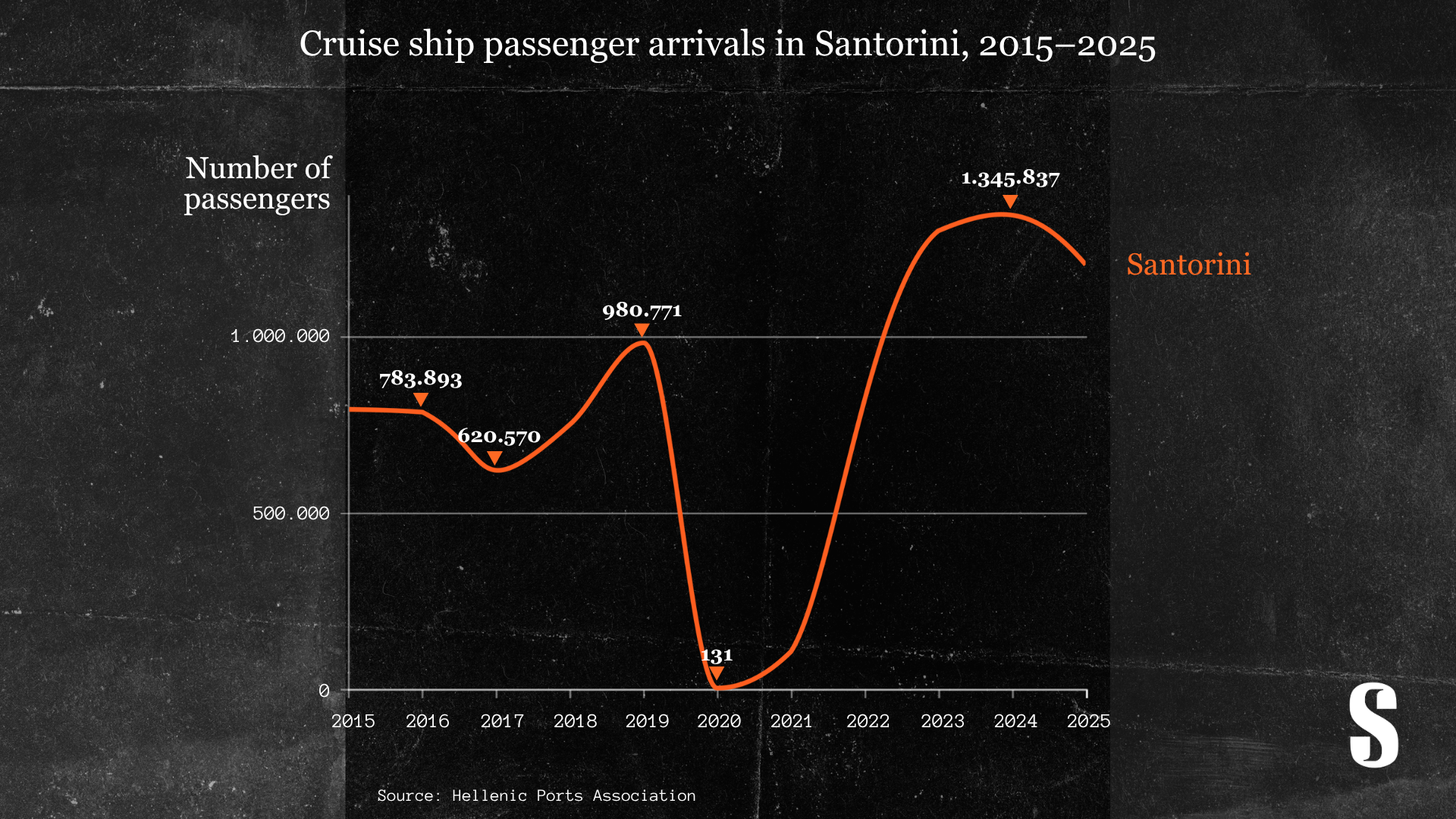
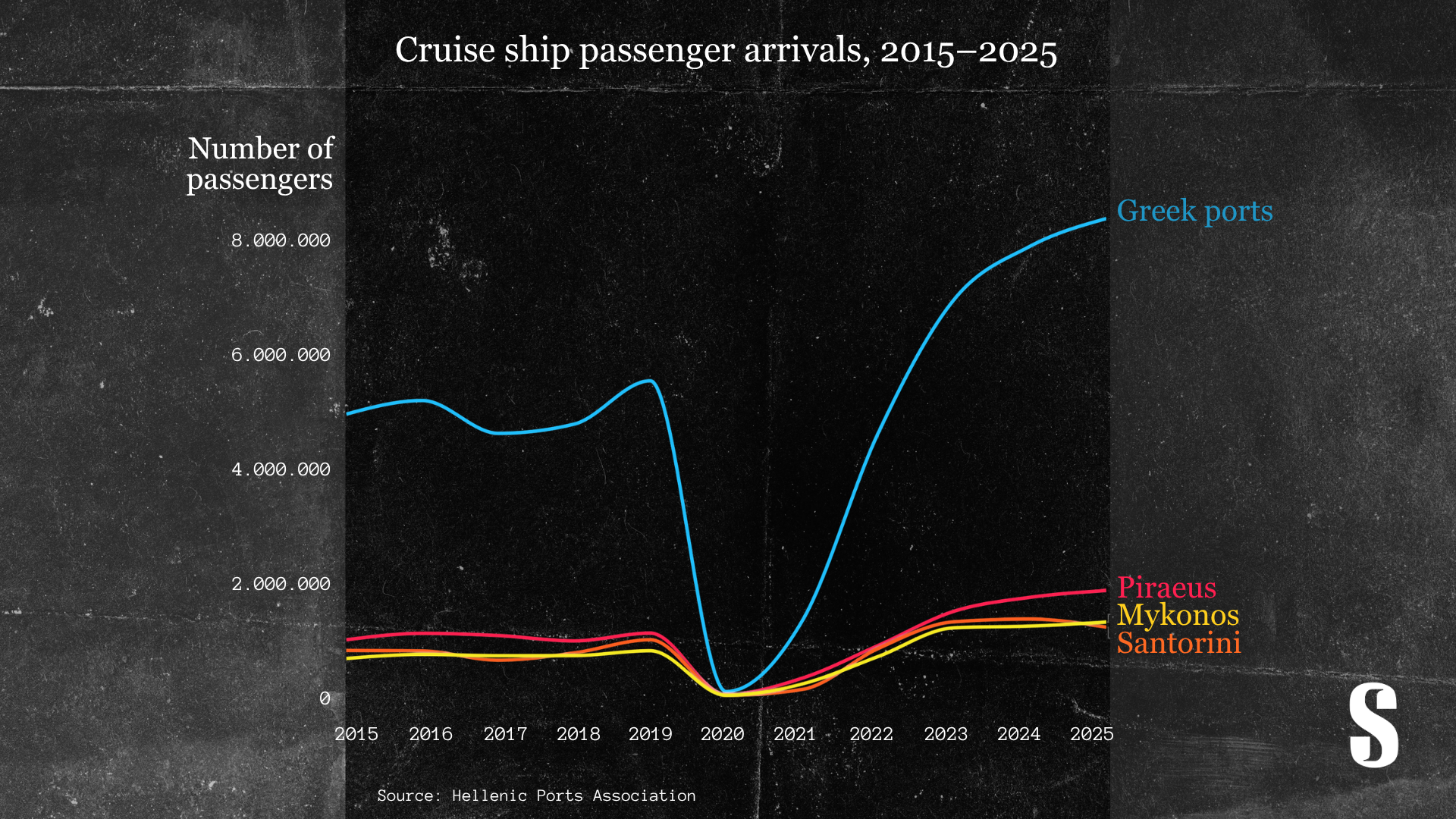
Santorini welcomed roughly 790,000 cruise passengers in 2015. By 2025, that figure had climbed to more than 1.2 million, making the island Greece’s third-busiest cruise destination after Piraeus and Mykonos.
Long before Royal Beach Club arrived, researchers had warned that the number of day visitors was placing increasing strain on Santorini’s roads, public services and visitor experience.
The trend is not unique to Santorini. Cruise tourism in Greece has grown rapidly since rebounding from the pandemic. After years of steady growth that came to a halt in 2020, passenger numbers began recovering in 2021. Since 2023, Greek ports have recorded a new record for cruise passenger arrivals every year.
For many residents, the debate is no longer simply about how many cruise passengers arrive. It is about what they contribute once they do.
Who benefits?
The question of whether cruise tourism delivers meaningful economic benefits to local communities is not a new one.
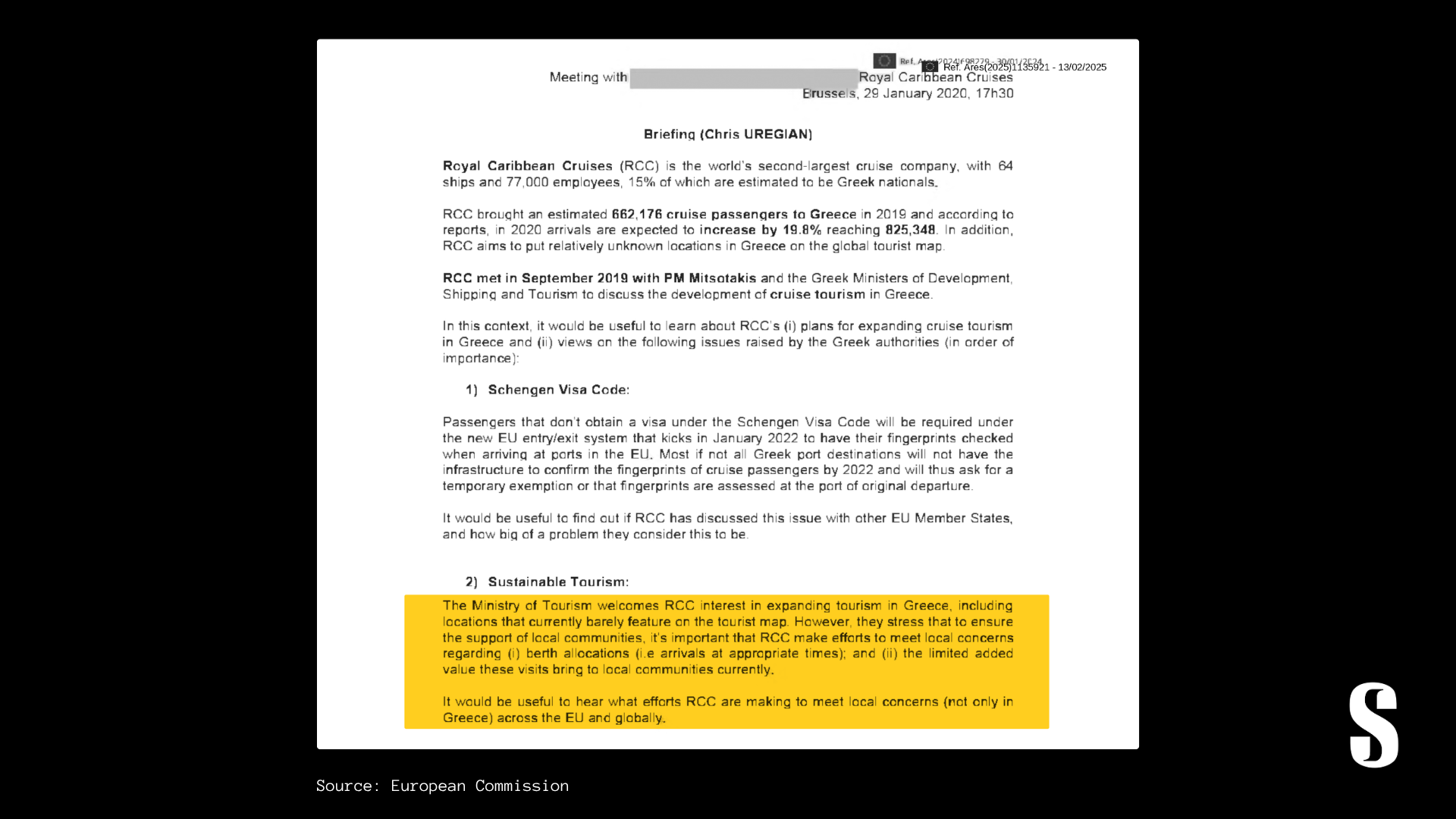
The issue appears to have been discussed during a 2019 meeting between Royal Caribbean executives and Greece’s Ministry of Tourism.
According to internal European Commission documents reviewed by Solomon, ministry officials welcomed Royal Caribbean’s interest in expanding tourism in Greece, including to “locations that currently barely feature on the tourist map.” At the same time, they urged the company to address concerns over berth allocation and what they described as the “limited added value” that cruise visits were providing to local communities.
Six years later, during a September 2025 meeting with Royal Caribbean executive Alessando Carollo, Greek Minister of Tourism Olga Kefalogianni and Minister of Shipping Vasilis Kikilias reaffirmed the government’s support for the cruise sector.
Minister Kikilias described cruise tourism as a “force multiplier for the national economy and the Greek islands.”
Yet despite years of debate – and repeated government assertions about the sector’s economic importance – there seems to be remarkably little official evidence showing how much cruise passengers actually spend in destinations such as Santorini.
Solomon asked both the Municipality of Thira and Greece’s Ministry of Tourism whether they collect or maintain data on local spending by cruise passengers.
By the day of publication, the ministry had not responded.
The municipality provided information on the revenue from the €20 cruise passenger fee but not on passenger spending in the local economy.
Giorgos Diamantopoulos, secretary general of the Thira Commercial Association, said that on average, every cruise passenger spends roughly €80 on transportation – including the cable car, bus transport, and the cruise passenger tax.
“Everything beyond that – whether they spend money on the island or not – is, how should I put it, speculative,” Diamantopoulos said.
Without such data, one of the central claims underpinning cruise tourism – that large passenger numbers translate into substantial economic benefits for local communities – remains difficult to verify.
The gap between visible pressure and measurable economic benefit became a recurring theme during Solomon’s reporting on the island.
Over three days of reporting in Santorini, Solomon reporters observed roads crowded with buses transporting cruise passengers between ports, beaches and villages. Parking lots overflowed with coaches waiting for excursion groups. One tour escort recalled waiting more than 25 minutes simply for a bus to exit a parking area in the town of Oia.
Yet despite the constant flow of visitors, many businesses told Solomon they were seeing fewer cruise customers than ever.
“We don’t even sell bottles of water anymore,” one shop owner near the old harbor told Solomon.
To people who have spent decades working in the cruise industry, that apparent contradiction makes perfect sense.
A day already sold
Cruise companies no longer earn most of their money simply by selling cabins.
Increasingly, they sell passengers almost every part of the journey: specialty restaurants, beverage packages, casinos, spa treatments, organized excursions, transportation and, now, branded beach clubs.
By the time passengers step ashore, much of their day – and much of their spending – has already been planned, booked and paid for.
Because Royal Caribbean accounts for roughly one in every three cruise passengers visiting Santorini this year, that strategy has implications well beyond a single beach club.
The result, critics argue, is that visitors still occupy the island’s roads, ports and public spaces, but spend less time – and less money – in the local economy.
A gateway, not a destination
That pattern is visible beyond Santorini.
Internal planning documents obtained by Solomon show how meticulously Royal Caribbean Group organizes passengers’ time ashore.
When one of its ships, Explorer of the Seas, docked in Piraeus on June 30, 2026, its more than 3,000 passengers could choose from 25 organized excursions. The itineraries included the Acropolis, Plaka, Monastiraki, Cape Sounion and Lycabettus Hill.
One place did not appear on the itinerary: Piraeus itself.
Although the ship had docked there, none of the organized excursions included the city. As other planning documents reviewed by Solomon show, Greece’s largest port functioned primarily as a gateway to attractions elsewhere in Attica rather than a destination in its own right.
Solomon requested Royal Caribbean Group’s comment on the broader economic benefits of its operations in Greece, including concerns about the benefits to local communities, its passenger volumes, the Royal Beach Club in Santorini and its expansion strategy in Europe.
The company did not respond by the publication deadline.
The hidden costs
For local officials, the debate over cruise tourism extends beyond economics. It is also about the environmental and infrastructure costs of accommodating hundreds of thousands of passengers who spend only a few hours on the island before returning to their ships.
Cruise ships can remain at anchor off Santorini for much of the day before departing for their next destination. While passengers are ashore, the vessels continue operating, generating electricity on board to power air conditioning, kitchens, restaurants, pools and entertainment venues.
Based on Solomon’s analysis of data from the Santorini Port Authority, cruise ships are expected to remain at anchor for an average of 11.5 hours during visits between June and August this year.
Depending on weather conditions, the ships’ distance from shore and other factors, nearby communities may also be exposed to emissions produced while vessels are in port – and not just in Santorini.
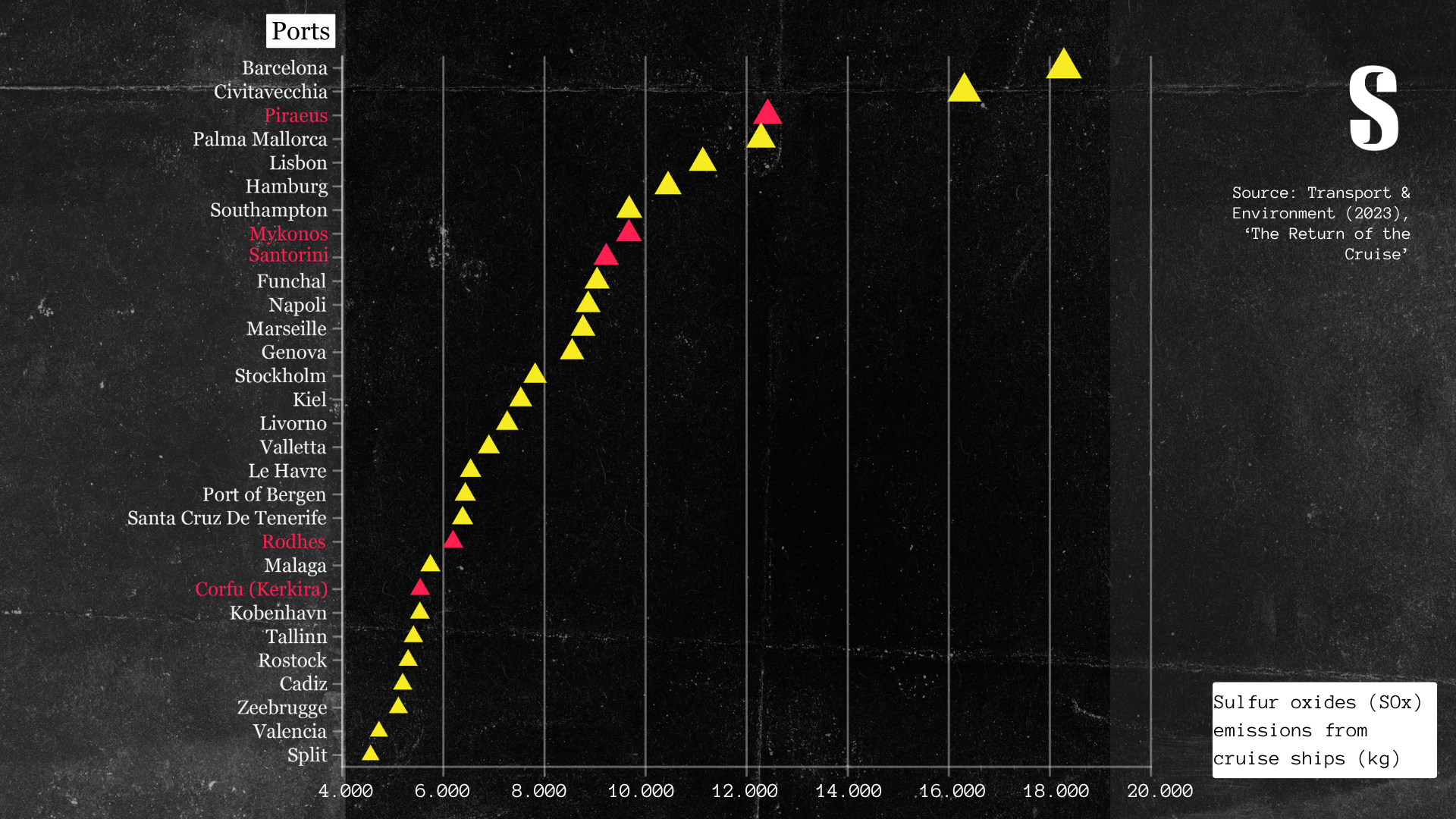
In a 2023 report examining pollution from cruise ships across Europe, the Brussels-based organization Transport & Environment ranked Piraeus as the continent’s third-most polluted port for sulfur oxides (SOx) emissions from cruise ships. Mykonos ranked eighth and Santorini ninth among the 30 ports included in the study.
Cruise ships account for less than one percent of the world’s commercial fleet, according to a report by the CLIA. Yet because they are among the largest and most energy-intensive vessels at sea, they generate disproportionately high emissions on a per-ship basis, according to Transport & Environment.
“For Piraeus, cruise shipping is the cherry on top,” said Nikos Michalopoulos, director of the Institute for Environmental Research and Sustainable Development at the National Observatory of Athens. Because the port is already dominated by emissions from commercial shipping, ferries and other maritime activity, he said, it is difficult to isolate the contribution of cruise vessels. Islands such as Santorini, where cruise traffic represents a much larger share of maritime activity, offer a clearer picture of ships’ environmental footprint.
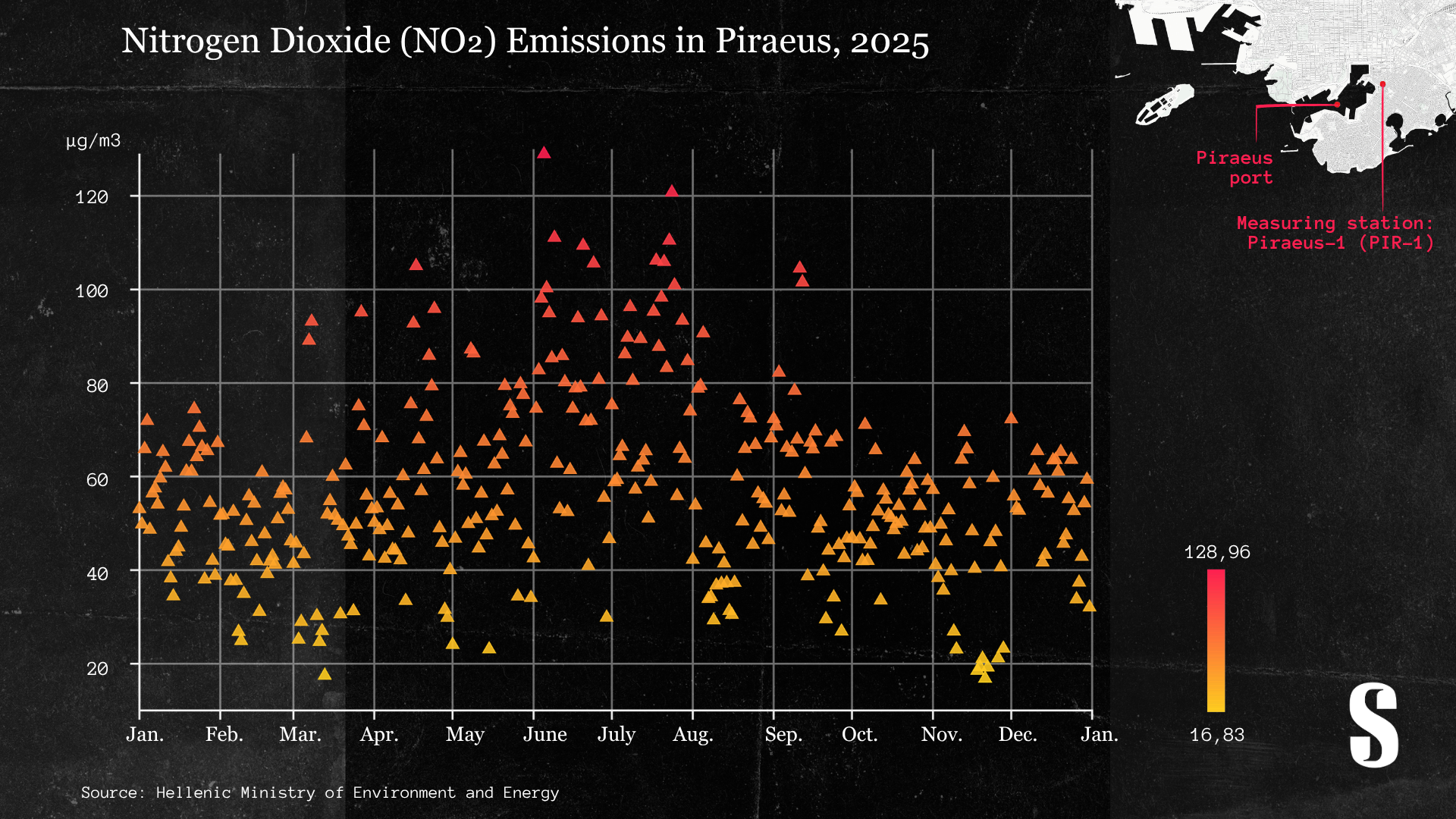
Research published in 2025 by the National Observatory of Athens found that shipping is a major contributor to air pollution around the Port of Piraeus. It found that passenger vessels make an even greater contribution during the summer months, when maritime traffic peaks.
The findings underscore a broader point that critics have been making for years: the impact of cruise tourism is measured not only by the ships anchored offshore, but also by the buses, taxis, parking facilities and road networks needed to move thousands of visitors through destinations in just a few hours.
What kind of tourism?
For many people working in Santorini’s tourism industry, the greatest concern is not simply congestion or pollution.
It is what the island risks becoming.
Several tourism professionals with decades of experience told Solomon that Santorini has gradually lost the kind of visitor who returns.
The industry calls them “repeaters” – travelers who spend several days on the island, discover places beyond the postcard views and often come back again.
“We’ve lost the visitor who says, ‘I went to Greece, I had a wonderful time, I’ll come back,'” said Chara Ampeliotou, a tour guide who has worked on the island for 35 years.
Antonis Pagonis, president of Santorini’s hotel association, believes the island bears some responsibility. “Santorini stopped caring about creating repeat visitors,” he told Solomon.
Mayor Nikos Zorzos argues that the island now faces a broader choice about the future of its tourism industry.
“Santorini is more than sunsets and romance,” he said. “Visitors should experience local life. They should discover the island’s history. Very few people visit the archaeological sites or museums. That’s the direction we would like tourism to move.”